Search This Blog
Wednesday, October 9, 2013
The Music of The Wicker Tree (2011)
The mixed reception of Ridley Scott's Prometheus (2012) reinforced my appreciation for Robin Hardy's The Wicker Tree (2011). Despite Prometheus' successes, that film is plagued by evidence that it is not a pure vision of what its chief creators intended. With the competing interests of the studio, director, writer, and re-writer all at odds, there were too many chefs in that kitchen. It's a shame, because it taints the strong underlying material.
In contrast, The Wicker Tree is a complete vision. Hardy made his directorial debut in 1973 with The Wicker Man, an adaptation of a novel by David Pinner. Hardy's career has been quiet ever since. He directed one film in 1986, and appears to have done nothing but writing before returning to the Wicker universe.
In 2002, Hardy sought funding for a sequel to The Wicker Man, but coming up empty handed, he wrote his idea as a novel, which was released as Cowboys for Christ. Writing the novel solidified Hardy's vision, and he adapted his own work into the screenplay for The Wicker Tree.
"It really is another world over there in America, isn't it?"
The Wicker Tree is about culture clash. Two Christian missionaries from the United States, Beth and Steve, travel abroad to preach to Scottish pagans, and wind up ritually sacrificed to a fertility cult. From the UK himself, Hardy uses the Wicker universe to paint a caricature of evangelical Americans. And if we may borrow from an interpretation of Eli Roth's Hostel (2005) (that the Europeans who torture tourists for sport are commentary on how U.S. Americans uniquely misunderstand the rest of the world), the evil pagans of Scotland may stand for the missionaries' misunderstanding of other cultures and traditions. These Scots are kind of a caricature of the enemy "out there," the heathens outside the evangelical faith community. They are habitual sinners at best, and murdering cultists underneath.
The mutual misunderstandings between the evangelicals and pagans are often sources of dark humor in the film. Both groups underestimate each other, and through their mutual ignorance, the film satirizes the evangelical worldview without completely abandoning its adherents to parody. Beth and Steve may be naive, but they are written as good, sympathetic characters. They face personal struggles as they strive to do good in their commitments to their faith, and their pagan hosts are wrong to dismiss them as fools.
A continuum of the use of music in film
Hardy's film stands out because of the importance of music in developing the characters, moving the plot forward, and reflecting the themes developed therein. To me, this is the apex of telling a story not just in the script and on the screen, but in the audio track as well. When I imagine a continuum of the creative use of music in the horror film, it looks something like this:
I. No Music
A film rarely has no musical score. Besides The Birds, which truly had none, the final scene of Play Misty For Me comes to mind (ironically, as the title refers to a jazz standard) because there is no score accompanying the final confrontation between Dave (Clint Eastwood) and Evelyn (Jessica Walter), which today seems like a strange choice. Without music to create tension in the scene, their combat is a comically anticlimactic series of grunts and punching noises leading up to the end credits.
II. Atmosphere and Cues
Most films fall into this category. Psycho is famous for it's repeated themes and jarring cues that accompany the shocking scenes, and showcases the effectiveness of the strategic placement of music in a film.
III. Relevant Music Originating in the Fictional World
Sometimes, music played or listened to by a character in the film serves the dual purpose of contributing to the atmosphere of the scene while servicing the plot. In Blade Runner, the atmospheric music fades as Rachael noodles at a piano, then returns to play alongside the piano. The piano and background music are in different keys, but are harmonically relative, and the effect is haunting. In The Strangers, Kristin and James listen to Gillian Welch's "My First Lover" on vinyl, and at one point, an intruder jostles the turntable, causing the phrase "quicksilver girl," with its jarringly unconventional harmony, to repeat over and over. The sound hides the footsteps of the intruder, and the repeating melody acts as a tense score to a tense scene. Similarly, Funny Games begins with the protagonists challenging each other to guess the title of the classical compositions playing on their CD player. The lilting music is harshly interrupted by John Zorn's "Bonehead," which foreshadows the use of that same track on CD by one antagonist to cover his own footsteps as he searches for an escaped captive hiding in an empty house.
IV. Music From the Fictional World Acting as Text and Subtext
The Wicker Tree features traditional atmospheric and incidental music, but is noteworthy for featuring music that furthers the plot while furthering the themes, with the lyrics and harmony speaking symbolically about the characters and the relationships between them. The filmmakers have crafted a depth of culture for the fictional characters, but the songs also organically introduce subtextual themes while fleshing out the characters, and while serving the usual role of providing atmosphere to the scene in which they are featured.
The Songs of The Wicker Tree
"I Know Where I Am Going"
The film opens with Beth's voice singing a traditional Scottish (or Irish) folk song, which is fitting in that Beth soon travels to Scotland. The performance introduces the audience to Beth's pure singing voice. Though she speaks with a Texas twang, her singing voice is generally free from inflection. She has the control and technique of a formally trained singer, and her performances have the formality of musical theater, rather than the informal affectations of popular music styles.
Harmonically, the song follows simple I-IV-V chord changes common to Western folk music. Lyrically, it is a secular love song with a noticeably Scottish vocabulary, particularly from the use of "bonny," meaning "physically attractive." The song is an example of how European folk music begat so much of the popular music of the United States; more broadly, how European influence shaped the cultural, artistic, and religious traditions in America.
Second song, based on Luke 1:54
In a scene in her church Beth sings a Christian country song. The song appears to be an original paraphrasing of Luke 1:54 set to music. She is accompanied by piano, mandolin, acoustic guitar, and a drummer playing a two-piece kit with brushes. Hardy pays attention to detail- the instruments you see are the instruments you hear. The instrumentation is a cross between traditional bluegrass and acoustic country music, and gives some background to the religious culture Beth and Steve hail from. There's no gospel choir, nor is it Christian contemporary rock. It's Texan country music, with a biblical bent. It's harmonically and rhythmically positive and upbeat. For these Christians, we see that churchgoing is a way of life, and it's fun-- not at all distinct from leisurely pursuits.
"The Canticle"
Beth's next performance takes place in a large Scottish church. Accompanied by an orchestra, she sings an original arrangement with lyrics credited to Handel (based on the phrase "I know that my redeemer lives," originally "liveth" in Handel's Messiah Part III). This piece is a departure from the informal music Beth has already sung. The townspeople set up a microphone for her because, as Lady Delia says, "none of these pop people can really sing." But Beth graciously shakes her head and begins to sing perfectly audibly in a rigorous formal style that projects over the instruments. Her pitch is perfect, and she displays an enormous octave range in full voice. Beth proves that she has appreciation and ability for the highly-demanding classical tradition and its connection to an historical form of religious worship. To the surprise of others, Beth demonstrates through this performance more depth to her musicality, and to her religious conviction, than what we have seen up to this point.
"Trailer Trash Love"
A local television station covers Beth's performance at the church, but for contrast shows a music video Beth starred in as a secular country music artist before being "born again." Her midriff is exposed over a pair of Daisy Dukes, and she chirps out suggestive lyrics. Most relevant to her imminent lifestyle change is the line "There are pleasures in Heaven and God above/But baby, nothing compares to my trailer trash love." The way the old Beth sang this song makes her more endearing. Her voice on that raunchy pop-country number sounds like a trained singer jumping into rock music for the first time. This is because singers who are used to singing in church or in musical theater are often not accustomed to the different skill set used in popular music forms. Learning to stop enunciating so carefully, when to use contractions, how to slide between pitches, when to apply vibrato, and adopt inflections comes from imitating other singers. Beth instead sounds like a talented theater kid doing Carrie Underwood karaoke.
This is not criticism of the actress (Britannia Nicol); it helps the impression that Beth was plucked from the church and placed in an industry where her body was more important than her talent. Poor Beth is ashamed of herself for that period in her life, even though it's likely that whoever produced that video intended to exploit her.
"The Laddie Song"
"Will you go, Laddie, go, to the breas o' Balquhither / We'll crown the Laddie's queen and we'll feast the night together / Will you go, Laddie, go."
Film is usually thought of as a visual medium, but because it is also a narrative, it can employ literary devices. A skilled filmmaker usually reflects the virtues of literature by using literary devices within visual cues or dialogue. It is more unusual to rely so heavily, as this film does, on film music to convey plot or subtler devices. Here, Steve has just finished performing an elaborate card trick based on significant numbers in the Bible, and in doing so, he shows himself to be "above" his audience in that he no longer gambles, but still has mastery over the cards themselves (even when one man shuffles the deck mid-performance). As Steve completes the trick, however, the pianist begins singing "The Laddie Song." The song quite literally foreshadows the fate the townspeople have in store for Beth and Steve... a ritualistic crowning and a cannibalistic feast. The song is even picked up in the next scene by the seamstresses, singing a capella as they sew the May Queen's dress. In the earlier scene, the song is sung in defiance of Steve, as though the pub patrons are joking about his impending murder right under his nose. In the next scene, the song is sung absently to pass the time, foretelling that the entire community is in on the conspiracy, but that to them it is a fairly pedestrian annual ritual.
"The Fruity Song"
As Steve ascends the stairs to his room at the inn, a woman at the piano sings an innuendo-laden song, full of golden apples, ripe cherries, etc. The tune is slow and sorrowful as the narrator recalls a past lover. The singer comes across as a sexy older woman; both Steve and the men in the pub watch her attentively as she sings. That she is nearly twice Steve's age yet evoking sexual encounters from her youth makes Steve question his promise of abstinence. He seems to fixate on what he is missing out on, visualizing Beth covered in fruit as he lies awake on his bed, and he soon cheats on her with a seductive young woman. He had struggles with his commitment to pre-marital chastity in earlier scenes, but the song seems to push him to break his promises and partake in the sexually liberal world he and Beth have entered. Once Steve finally has sex, he is doomed under the slasher paradigm of "vice precedes slice-and-dice." (And the apparent implementation of this paradigm leads us to believe that the virginal Beth will escape as the "final girl..." which makes the twist all the more wicked.)
"Power in the Blood" and "Power in the Blood 2"
"Would you be free from the burden of sin? / There's power in the blood, power in the blood / Would you o'er evil a victory win? / There's power in the blood of the lamb / There is power, power, wonder-working power in the precious blood of the lamb"
This is a traditional gospel song, recorded many times over. It appears in the film in two different arrangements. The first is the traditional version, a simple I-IV-V progression common to gospel, bluegrass, and country. The second is an a capella arrangement with the melody reconfigured into the notes of the much more sinister-sounding melodic minor scale. Graham McTavish does not sound like a trained singer, which incredibly makes the transposition of the melody sound less like artifice and more like his inability to sing the tradition version correctly. It sounds like he's fumbling for the correct pitch, but the intervals he lands on are carefully chosen for their foreboding character.
In the earlier scene, Beth preaches to the pagans and then encourages them to join her in singing the song as Steve distributes the lyrics. The group perks up and joins in, with at least one member truly getting into it with an impromptu harmony. In the later scene, Sir Lachlan begins singing the minor key version as he and his followers advance upon the cornered Steve, preparing to devour him. The pagans join him in shouting the chorus and pumping their fists in a militaristic fashion.
This twist is brilliant. In its first iteration, Beth encourages her audience to convert, so that they may be liberated from their pagan sins. The song calls up the age-old imagery of the blood of Christ, the lamb of God, the spilling of which washed away the sins of man. To Beth, this is standard doctrine, but to her listeners, it is not so far removed from its literal meaning. For the imagery, nay, the practice of the sacrificial lamb is older than Christianity, and the literal spilling of blood for the greater good is something the pagans can endorse. The evangelicals believe their message is getting through, but the would-be converts have instead tapped into a hidden common ground between their faiths-- this violent image. For Beth, the "power in the blood" is rhetorical, but for Lachlan's followers, it is still quite literal. Two millennia prior, Beth might have felt the same.
The best aspects of Beth's character are her respect for the past, as shown by her appreciation and mastery of sacred music and her commitment to abstinence (an old-school concept, anymore). But her downfall was in failing to be able to relate to the pagans of Scotland. She believed too fully in the power of her form of evangelical Christianity, a very recent offshoot of the Abrahamic tradition, but she failed to see the danger she faced, a literal acting-out of the sacrificial lamb image at the root of her own faith. Perhaps more importantly, she should have seen the similarities between their respective traditions and left the Scots in peace instead of questing to convert them. After all, the evil committed by the pagans was guided by Sir Lachlan to hide his corporation's responsibility for the pollution of the land and sterilization of the people.
"The Anthem Duet" and "The Anthem at the Tree"
Both songs are original arrangements with lyrics taken from "Osin in the Land of Youth" in the Poem of Osin (or more commonly, "Oisin," the great warrior-poet of Irish mythology).
Beth joins a young man in a duet at the piano as he sings: "The feast shall cloy not, nor the chase shall tire / Nor music cease for ever through the hall / The gold and jewels of the Land of Youth / Outshine all splendours ever dreamed by man / Thou shalt have horses of the fairy breed / Thou shalt have hounds that can outrun the wind / A hundred chiefs shall follow thee in war / A hundred maidens sing thee to thy sleep."
At the climax, the defeated pagans sing in mournful defiance as they retreat from Beth: "Delightful is the land beyond all dreams / Fairer than aught thine eyes have ever seen / There all the year the fruit is on the tree / And all the year the bloom is on the flower / There with wild honey drip the forest trees / The stores of wine and mead shall never fail / Nor pain nor sickness knows the dweller there / Death and decay come near him never more."
The "Land of Youth" refers to Tír na nÓg, an earthly paradise inhabited by supernatural beings that fortunate travelers might happen upon. The description from the song is very similar to descriptions of Heaven, but Tír na nÓg is an earthly reward, and plays into the differences between the evangelical and pagan worldviews. Their villainy aside, the pagans in the film worship fertility and endorse sexual gratification. In a way, they find their fulfillment in the satisfaction of their earthly desires, making the most of their lives in an immediate way. Contrarily, the evangelicals condemn those behaviors and practice modified asceticism in anticipation of a reward in the afterlife.
The song, with it's idyllic imagery, posits that Heaven exists on earth and there is no reason to deny it. Beth sings along at the piano, unable to see the ideological struggle in which she is participating. And yet at the climax, having burned Sir Lachlan alive for murder, she asks the pagans, "Don't you have a song for this? 'Auld Land Syne,' perhaps? Oh, you don't like that one! How about your 'Laddie' song? I don't really know the words, so you'll have to help me!" Beth calls them out as being nothing without their songs and rituals, and she appears to have won the day when, without their leader, they retreat from her. Can her criticism be turned against her? From the beginning, her faith has manifest itself in song and performance, which makes for a good show, but says nothing about the depth of her spiritual experience. Her singing talent made her a star in the church in the same way it almost made her a sexualized starlet in her secular career. At this moment, she thinks she has won because she thinks the pagans are all singing and no conviction. The pagans thought the same about her when she arrived. Beth showed her substance through the strength she exerted to fight her own worldly desires, pressures from Steve, and the pagans' violent scheme against her. The pagans proved their conviction by eventually making good on Lachlan's plan.
Closing
I first watched The Wicker Tree over a year and a half ago, probably not long after the last time I wrote anything for this blog. It is an uncommon film, and my appreciation for it has only grown in the interim. It is campy in places, sure, and its dark humor seems out of place, but it is also scary, full of social critique, and an outstanding example of using film music to tell a deeper story than would otherwise be possible.
John Kenneth Muir, my genre criticism hero (and occasional reader) maintains that the highest success of a film is that its form reflects its content. In a rare way, The Wicker Tree's form does so, not just visually, but audibly. I think that's quite an achievement.
Tuesday, April 3, 2012
Preserving a proud moment
Link to Reflections on Film and Television
Having my name mentioned on the other end of the above link was a great honor, and I'm making a brief entry here to preserve it.
Unfortunately, I have no new material to share, as I have not seen a genre film that's gotten me fired up in quite a while.
Having my name mentioned on the other end of the above link was a great honor, and I'm making a brief entry here to preserve it.
Unfortunately, I have no new material to share, as I have not seen a genre film that's gotten me fired up in quite a while.
Friday, February 10, 2012
The Mischaracterization of the Thing in The Thing (2011)

For a detailed discussion of van Heijningen Jr.'s 2011 remake/prequel of The Thing, I refer you to noted genre critic, John Kenneth Muir.
Here, I'd like to focus on the characterization of the Thing (the eponymous alien creature)as it differs from John Carpenter's original.
The Monster
For a refresher, The Thing is an alien life form that crash-landed in the Antarctic aboard a spacecraft several millennia before the present. Freed from the ice by its discoverers, the Thing shape-shifts and infiltrates the ranks of the humans in order to survive. Once the Thing consumes another living being, it assimilates its DNA, gaining the ability to replicate the original perfectly, including speech. In the films, it is shown taking the forms of humans and sled dogs. It is revealed in the remake that the Thing cannot reproduce inorganic matter, like tooth fillings or body jewelry. The monster's modus operandi is to impersonate an assimilated human character, then attack when the opportunity arises, typically when it is alone with a single non-Thing. When making its move, or when threatened, the Thing blows its cover, and its assumed body morphs into a nightmarish kaleidoscope of flesh. Lacking true vital areas, the Thing is impervious to anything but fire.
How the 2011 Creature Was Mischaracterized
Many complaints have been made about the 2011 film's use of CGI over practical SFX. That debate aside, I see a shortcoming in the storytelling. The monster in the remake lacks desperation. In the original, the Thing is relatively weak. That is why it hides in the guise of something familiar. Against a group, the monster tends to lose fights. It only transforms to attack a lone victim, or to defend itself when cornered. The Thing is very careful, which is what makes it so frightening in the original. It knows what to say and how to act to gain your trust. And because its stealth is its greatest asset, it only transforms as a last resort. The transformations are defined by their irrationality: on screen, we see a perfectly ordered human body devolve in an instant into a writhing, gory chaos.
Most importantly, if the Thing can become anything, it would become the perfect killing machine. But it doesn't, because in its transformation scenes, the Thing is panicked, and as a last resort, it attempts to become everything at once. Like a frightened animal, its chief defense is to make itself larger and wait for a chance to escape. In the original, the transformed Thing is not coordinated enough to be effectively mobile; its form becomes too disordered. Each confrontation typically results in the Thing transforming and taking the nearest person by surprise. Then the other humans regroup and torch the Thing.
The 2011 film fails to appropriately characterize the Thing with enough desperation. These transformations have a much more ordered form and function. Basically, the 2011 Thing hides by shaping its body into a familiar shape, and when confronted, it distorts that shape into a more lethal configuration, using the original body as source material. In one extended encounter, the Thing takes the shape of two bodies fused together, their limbs inverted into a powerful quadrupedal beast. In this shape, the monster stalks two characters through the Antarctic station.
This sequence makes little sense because it does not follow the rules of the original. (A) The transformed Thing does not take a rational shape, and is by extension not ambulatory in any conventional sense. (B) The Thing only attacks with an assured upper hand or out of total desperation. (C) The primary concerns of the Thing are stealth and safety.
By disregarding these rules, the filmmakers put the visual style of the monster ahead of its storytelling purpose. It simply makes no sense that the Thing would take on these particular grotesque forms in their respective contexts. The quadrupedal only exists to allow a chase scene to take place. Similarly, the bipedal monstrosity at the end only serves to be something bigger and badder than we've seen before, as a visual crescendo for the film.
The monster's desperation should be key, I think. The original bleeds desperation: the humans and the Thing cannot coexist, and the remote location makes escape impossible. Meanwhile, the characters are confronted at every turn by a monster that circumvents their expectations of it and of each other.
The original film's triumph is that it gives us a monster that actually feels completely alien to us. It is probably no more sentient than a virus, and yet it must be confronted with intellect and diplomacy. It hides like a chameleon and freaks out like a decapitated chicken when cornered.
The 2011 film, on the other hand, makes the Thing entirely too relatable. In its different forms, it's essentially several conventional and recognizable monsters rolled into one. The film is further disserved by the incorporation of the spacecraft into the main plot, when the Thing escapes from the Antarctic base, returns to the craft, and engages the engines before it is killed. From this, I gather that we are to conclude that the craft belongs to the Thing. If this is the case, what form does the Thing assume to man the controls of the craft? What configuration of limbs were the controls designed to accommodate? Where does the Thing intend to travel after escaping from Earth? All of these questions paint a far too rational image of the monster, which does not gel with the creature depicted in the original. True, the Thing arrives aboard a spacecraft, but I find it much more plausible that the Thing was a stowaway, like the Xenomorph in Alien. It follows that the Thing caused the spacecraft, constructed and piloted by another race of extraterrestrials, to crash in the Antarctic before it assimilated the bodies, leaving no trace behind.
I will say the following in praise of the remake:
1. The clarification about the inability to replicate inorganic matter is a good contribution to the mythos.
2. The character of Dr. Halvorson, an adaptation of Dr. Carrington from the "true" original, Howard Hawks' The Thing From Another World (1951), is a great use of source material not incorporated by Carpenter.
3. Kate's irrational need to justify herself to the Carter-Thing before burning it, even after she has determined it is non-human, is an inspired take on the classic "She's not a zombie, she's my mum!" conundrum.
4. The mischaracterization of the monster in the 2011 film has given me a new and much greater appreciation for elements of the 1982 version that I had overlooked before.
Tuesday, February 7, 2012
East Asian and Western Horror and Religion
The Autobiographical Portion
To situate this discussion, I should relate that I typically have less patience for supernatural horror than for the realistic. As a young child, I found the classic Universal monsters terrifying, but the advancing maturity that would dispel werewolves, vampires, and Santa Claus was no match for the sheer panic that Norman Bates caused me. To me, a realistic horror film will always be scarier than a supernatural one; that is, shocks and jump scenes aside, a realistic premise will always be scarier than a supernatural one because the bar for suspension of disbelief is much higher for a supernatural premise.
My taste for the supernatural does ebb and flow with the calendar, though. In the summer, for example, I find that I am more willing to soak up the unmemorable and formulaic slasher films of the 1980s and to catch up on the trends of mainstream genre offerings. Inversely, that reflective mood of the colder months raises my interest in the supernatural. I find myself drawn to the seasonally appropriate antiquarian ghost stories of M.R. James, or chipping away at my list of critically acclaimed but still unwatched supernatural horror films. That reflective state makes it easier to become absorbed in a work's atmosphere. Yielding to that atmosphere requires a suspension of disbelief in order to timetravel back to where and when hauntings and folktale monsters seemed more plausible.
My first experiences of the East Asian horror style were mediated ones: The Ring and The Grudge, both of which are American remakes of Japanese films. Despite the Americanization, the aesthetic and premise of each film is distinctly East Asian, belonging to a unique canon of horror films that has achieved international appreciation as a distinct subgenre . Dutifully, I sought out the original films, but in general, the supernatural premises had little impact on me. More recently, however, I've been interested in the relationship between Western and East Asian horror, and my own relationship to both. Through this ongoing project, I've discovered a few very enjoyable titles, and a new entry into my all-time top 10 horror films (Fruit Chan's Dumplings (2004)).
Hypothesis
East Asian and Western horror cinema reflect different bars for the suspension of disbelief, based on the relationship to religion and the supernatural in their respective cultures.
In terms of demographics, "The West" is difficult to characterize. The United States has an estimated rate of atheism or non-religion as low as 4%, while statistics in Europe are much higher, around 20-30% in the UK, and 20-60% around the continent. Sweden and Japan are both reported at a 60-70% rate of non-religion, while Vietnam alone claims a rate in excess of 70%. East Asia tends to be less religious than the US, but the statistics are skewed by the operating definition of "non-religious", which can encompass atheism, agnosticism, major non-theistic religions, and the non-identifying-but-still-spiritual. For example, the reportedly minimally-religious Vietnam is 85% Buddhist, a non-theistic tradition.
The key difference between East and West is not the number of adherents to any religious tradition, but the nature of the various traditions themselves. The West is primarily dominated by Christianity, the most prevalent of the Abrahamic religions. East Asian traditions are grouped under the heading of Taoist religion, though Buddhism embodies an intersection of the Dharmic (the heading for Buddhism, Hinduism, Jainism, Sikhism, and Zoroastrianism).
The Christian tradition revolves around central characters which represent external loci of the human experience. The exemplary lessons of Biblical figures and the drive to please God or follow the example of Christ draw attention away from the present and focus it on an external validation, with an eye to the goal of an afterlife.
In contrast, the East Asian traditions focus on something more immediate: the nature of the world and the proper way of being in the world. They can be described as a recognition of the order of Being and Nothingness, or as philosophies of living in harmony with the order.
So we have juxtaposed two predominating perspectives on the supernatural. In the West, there seems to be a natural world that may be influenced by external supernatural agents, where supernatural events can be attributed to the actions of agents that are circumscribed within intelligible definitions, e.g., acts of God, Satanic temptation, earthly visitation by Christ.
In contrast, the East Asian traditions exemplify the perspective of a supernatural world, where supernatural forces exist rather than intervene. In Western mythology, there appears to be a much brighter line between the natural and the supernatural. The Christian supernatural is defined by its strangeness, its difference from the natural. Christian history is sketched out in miracles and great paradigm-shifting events. The East Asian traditions are much subtler. They represent a perspective that sees the supernatural and the magical in the everyday. Concepts like ancestor veneration, animism, karma, meditation, and reincarnation are passive concepts that orient one towards a supernaturalist perspective on the world, an acceptance of the interconnectedness of all things. Note the difference between meditation and [the predominant interpretation of] prayer: the latter is a communication directed at something external, the former a reflection on the internal. Or consider the practice of ancestor veneration: the supernatural idea of continued influence in the world by the dead is fairly ancillary to the ritualized exercise of reinforcing, demonstrating, and feeling respect and appreciation for the importance of family. These practices speak to a perspective/lifestyle that observes the importance of human experiences through a lens of wonder and reverence, without bogging down in the consideration and validation of an externalized narrative of divine will and intervention.
From the outside, it seems that the nature of East Asian traditions as "perspective," rather that "belief structure," allows them to retain their relevance despite varying degrees of true literal belief among practitioners. That is to say, the literal truth of the supernatural seems to be less essential in the East than the West.
Comparative Horror Cinema
The West has dealt with its Christian mythology in horror films differently over the span of a century. The first 50+ years were dominated by adaptations European folk legends (vampires, werewolves, ghosts), These inevitably came into conflict with the forces of good wielding Christian faith in defense (the vampire's weakness to the form of the cross, etc.). The subsequent era of The Exorcist (1973), The Omen (1976), and Rosemary's Baby (1968) among others represents a radical shift. The religious horror themes draw on Satanic possession and the arrival of the Antichrist are much, much darker than their predecessors. Note that these are situated within a larger trend in cinema around the 1970s towards darker films that were more realistic, that depicted the world as ugly as it really is. Perhaps something about the darkness of these three films makes them more believable. In any case, these films lack any kind of levity, as though they are true stories, from an alternate reality.
By "alternate reality," I mean no disrespect to those whose religious beliefs encompass the possibility of events like those described in the above films. Still,I think one would be hard-pressed to find a Christian in the vast American mainstream who considers these films to be more than fantasies. And from this point forward, the religious horror output has been having to deal with the fantasy/reality conundrum as a matter of course. The average narrative presumes a secular world, then has to convince its audience and its characters otherwise. This fact suggests that the United States, with it's 96% rate of alleged religious conviction, still presumes a secular world on screen. I don't mean to moronically insinuate that any Christian faith that doesn't literally accept its historical baggage is somehow disingenuous. I only indicate that Christian mythology, on film, is no longer anything but a trope, a stock storytelling device.
The East Asian supernatural horror film reveals a different approach to the horror cinema experience. The ghosts, hauntings, and curses of traditional folklore are abundantly represented, but they are rarely independently antagonistic, as opposed to Western demons and monsters. Ghosts, hauntings, and curses are more commonly used as elements of a greater morality tale. They are supernatural vestiges of some wrongdoing, like a stain left on the world, and the characters of the film are drawn into conflict with the supernatural elements because they have some preexisting relationship to / culpability for this turmoil of the spirit world.
With no intercultural experience to speak from, I cautiously posit that in these compared storytelling traditions, the bar for the suspension of disbelief is lower in East Asian cinema than in Western. I think, given the nature of Eastern spiritual thought and its pervasiveness as culture and way of life rather than just religion, that films which draw upon those traditions are naturally more sincere in their use of supernatural themes. Because of this sincerity, I find it easier to be drawn into a film's world. Western supernatural films play too heavily on the audience's skepticism of its own cultural heritage, and such feats of dramatic irony or cheap twist endings are typically disappointing.
If someone could again handle Western mythology with the earnestness of Ingmar Bergman's The Virgin Spring (Sweden, 1960), I would be very impressed.
End
In closing, I recommend films like Kwaidan (Kobayashi, 1964), and Takashi Miike's "Box" from the Three... Extremes anthology (2004)and his "Masters of Horror" installment Imprint (2006). Each is presented in surreal, dreamlike style suggestive of ancient folk tales. The effect, particularly in Kwaidan, is in my opinion a great cinematic accomplishment and an alleviation of the burden of disbelief.
By way of a valediction, I ask: is it spirituality merely to keep an eye out for omens, to celebrate the rituals of holidays, to observe tradition, to hope, to embrace nostalgia, and to make note of coincidences? I think I could do with a bit more of all of that.
Saturday, November 12, 2011
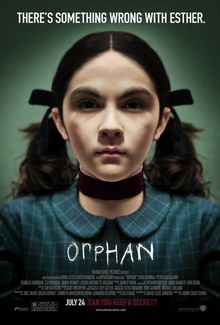
Orphan- Using the whole palette, plus the "vocabulary of the gun"
Jaume Collette-Serra's Orphan (2009) is, I think, quite a strong film, if you're not expecting too much. And that's perfectly fine. Because despite a kind of ridiculous twist, the film succeeds with a strong cast, an excellent execution, and by not betting too heavily on said twist. Consider for contrast something like Secret Window (2004). When a twist like that one is revealed, the film is pretty much over. There's plenty of cleaning up to do, like sorting out final confrontations, etc., but the twist is the most noteworthy point.
So if Orphan sounds appealing by contrast, see it. Because I'm gonna spoil this thing below.
---
For some reason, I am a fan of the "evil child" trope. Besides Orphan, a couple of examples that I really enjoyed, despite any shortcomings, are The Bad Seed (1956) and The Good Son (1993). With Patty McCormick in the former, and Macaulay Culkin and Elijah Wood in the latter, it's apparent that a good "evil child" film has to overcome the hurdle of finding the right child actor(s) to carry the film. In a horror film, the child is usually relegated to the back of the story, because killing each other and dealing with monsters and madmen are typically grown up chores. In addition, it's often inappropriate for kids to be too closely involved with horror subject matter. More often than not, a child just be something to rescue from harm's way. Using the child to tell the story is a taller order. Kubrick's The Shining is unusual in that a very young boy is one of its primary characters, and sometimes it feels like the film suffers because Danny is not a particularly dynamic character, but simultaneously benefits from a more restrained, realistic portrayal.
Orphan uses three exceptionally strong child actors, particularly eleven-year-old Isabelle Fuhrman as Esther. Esther is (spoiler) a 33-year-old psychopath with a (medically inaccurate) case of hypopituitarism that allows her to pose as a 9-year-old orphan whose modus operandi involves getting adopted, making advances on the father, and killing the whole family when she gets rejected. With this plotline, Furhman gets to play the angelic daughter, the disturbed child, the terribly unsettling underage seductress, and the murderous adult. She delivers each so convincingly that when it is revealed that Esther is not really a child, her character ceases entirely to seem like a child on screen.
Another, in my opinion, merit to the "evil child" trope is the fact that it can be presented to any audience. The same story, of the charming kid that no one is willing to believe has a dark side, is right at home in this R-rated production, something PG-13, a 1950s family movie or stage play (The Bad Seed), a made-for-TV movie, or a Saturday morning episode of "Goosebumps."
Orphan handles its scares in an unusual way. There is a repeated scene early in the film where the mother is in the bathroom, and a shaky camera is behind her head, suggesting someone is behind her. Then, her face is shown in the mirror, and as she closes the mirror, the space behind her is reflected. The first time, no one is there. The second time, her husband is over her shoulder, innocently enough. Similarly, there is one scene where the open refrigerator door is shown, suggesting that someone may be standing right behind it, but there isn't, and the classic throwing back the shower curtain but no one's hiding there scene. These scenes were totally "called out," as it were, in Scream 4 (2011) for being overdone, but clearly, in 2009 those moves were obvious enough to be played as they were in Orphan, extremely self-awarely. In a PG-13 film, these false alarms are some of the best material in the age-appropriate vocabulary, but in Orphan, they are understood by the audience and by the director to be too obvious to carry any weight.
But Collett-Serra understands that these moves are still fun; you just can't support a movie on them anymore. It's refreshing to see an R-rated film that really plays the whole spectrum for scares, rather than taking the gore to 11 the whole time. A couple of "no one in the mirror" scenes and a few speeding cars that for once don't splatter someone play significantly with the viewer's expectations, so that the actual violence is more impacting. A problem with a PG-13 horror film is that there is an unshakable safety in the knowledge that the violence is not going to get out of hand. The cool thing about Orphan is that it feels like a PG-13 movie most of the time, then turns on a dime and delivers those full-voiced, R-rated scares.
This type of plot is also able to do something unusual by giving the audience different kinds of experiences with the various sympathetic characters. Sister Abigail dies like a typical slasher victim. She's not a main character, and she's dispatched rather brutally. The murder of the father is particularly intense, because as a main character, he should be safe. We also get to experience the plights of the siblings and the mother, who bring differing youthful and mature concerns and interpretations of the situation to the table. They also have a lot in common. Usually, in stories like this one, the kids spend the whole movie meeting the burden of proof to convince the adults that something is wrong. Orphan puts the mother in that situation, which is a compelling complication. In identifying and sympathizing with the mother, we still get to feel that frustrated, childlike state of not being believed, which is absolutely critical to any "Goosebumps" plot (kids know there's a monster in the basement; clueless grownups refuse all evidence).
So Orphan employs the whole palette: the continuum between children's and adult's anxieties, the age range of child to adult actors, the techniques from innocuous scares to brutal horror, and the freedom of electing to keep with or break from tradition with a timeless trope. Like Pan's Labyrinth, Orphan is a grown up, edgier version of the same fears we've harbored, not just historically, decade by decade of filmmaking, but as we've grown up with horror.
If you've "grown up with horror" at all like I have, from Alvin Schwartz stories, to Goosebumps, to the Universal monsters, Vincent Price, Psycho, The Shining, all the way into anything from F.W. Murnau to Takashi Miike, then I shall hope that Orphan will feel very natural to you.
-----
A couple of additional notes of praise:
I liked very much the way the last few minutes were handled. I was immediately suspicious that Esther was not down for the last time in the greenhouse, and of course, when the police arrive, her body is gone. Her next appearance is shocking enough, but it's not wasted in a final jump scene. The film continues to overcome stereotypical silly endings in the last struggle on the frozen lake. Orphan could have adopted the overdone ending of giving Esther a quick back-from-the-dead jump (Fatal Attraction, Children of the Corn,) before being decisively killed, but this film sidesteps by letting Esther understandably survive a clearly non-lethal injury. Her next appearance is not wasted by having her appear one last time just to get really killed. The fight between Esther and the mother on the frozen lake is worth it, and that scene isn't wasted with what seemed like the obvious stupid conclusion: the youngest daughter taking the pistol and shooting Esther as she attempts to stab the mother. Thankfully, the daughter misses in an age-appropriate fashion, breaking the ice open. For me, the commitment to not making stupid obvious choices more than makes up for the silly last "badass line," a cliche which has never, and probably will never, ever, be delivered convincingly. Because people getting stabbed are not going to pause to say something awesome right before they kill their adversary.
And as a general rule, guns are not scary in movies. Are they too pedestrian? Too impersonal? For some reason, giving Esther a revolver in this film works. Perhaps it's because a gun is usually given too much screen time, across all genres. Suspense is derived from the presence of the gun, which may or may not be fired. Such scenes tend to play like one of Tarantino's Mexican standoffs. Strangely, the presence of guns in a scene tends to encourage rational conversation, because no one wants to pull the trigger (otherwise, they would have done it already). A gun is such a symbol of strength and power- it appears as an assured kill, and any character who has been shot is presumed dead, until they make some remarkable recovery. Because a gun is a symbol of strength, that symbolism is typically deconstructed/reversed/undone as a way to throw off the audience. With a defensive weapon, the wielder's safety is ensured in the eyes of the audience... right before he's stabbed in the back. As an offensive weapon, it raises the strength of a villain to its highest point, such that it must be immediately undone by some surprising heroism from the would-be victim, like the final basement shootout in The Silence of the Lambs. Orphan manages to creatively expand the vocabulary of the firearm, making it scary for once. I was not convinced before that it could be done.
Wednesday, October 19, 2011
Thinking Too Hard About Forbidden Planet... the "plastic educator" as a thought experiment towards epistemology and theology
Fred Wilcox's Forbidden Planet (1956) is a sci-fi classic. It's imaginative premise carries it, in my opinion, into the realm of sci-fi horror, and into the jurisdiction of this blog. My project tonight is to develop further the argument I got into after I saw it. I don't intend to detract at all from the film, only to use it as a jumping-off point.
The action takes place on planet Altair IV, as an expedition arrives to investigate what happened to an early expedition crew on the planet. Two inhabitants, Dr. Morbius and his daughter, remain after an unknown force destroyed the other members of their expedition nearly 20 years prior. Morbius is engaged in the study of the Krell, a race that lived on Altair IV but disappeared completely in a single night 200,000 years earlier, immediately after making their ultimate technological achievement. That piece of technology is the "plastic educator," which allows for the 3-dimensional projection of thoughts from the user's mind. What killed the Krell, what destroyed Morbius's expedition crew, and what threatens the new expedition, are revealed to be monsters from the id (the Freudian subconscious). One monster was created by the Krell when they first used the plastic educator, and Morbius inadvertently did the same when he used it.
The monster that is created by the plastic educator is a three-dimensional manifestation of the id of the user. So here is my essential question:
Let's assume that the plastic educator operates like a three-dimensional printer, but with access to any raw material, such that it could theoretically, with appropriately detailed instructions, "print" a living thing... Assuming the theory behind the machine is sound, could it work?
I think not, because of the limitations of human knowledge, which are insufficient instruction for even an advanced technology such as this. This impossibility, I think, points us at the philosophical underpinnings of Christian creation mythology.
The Limits of Human Knowledge
It is a common contention to argue that man cannot interact with the world itself; that his perceptions are always mediated by the the limitations of his senses. As such, he always perceives phenomena, not as they are, but as they appear to him. The most that man can know about an object he encounters is merely the surface character of the object. Any object has a horizon; the viewer, confined to a single perspective, cannot perceive, for example, both faces of a playing card at the same time. The way that the viewer assimilates these surface impressions with prior experiences (that a card has two faces, and that the hidden face continues to exist when not in view) is referred to among phenomenologists and psychologists as "apperception." Man's interactions with the world are solely his apperceptions of sensory phenomena interpreted through the history of the individual's experience.
What does it mean for man to "know" an object? Given that a corporeal object has objectively real characteristics, the problem remains that man cannot know them. He has an apperceived representation in his mind of what a "playing card" is, but he cannot, with exactitude, fully know the objective qualities of the jack of clubs. He does not know what the shape of the card is, really. He can use a ruler and protractor to measure the lengths of the edges and the curvature of the corners, but this is merely an analogy, an interpretation through the constructed language of numbers and committed to memory after the measurments have been made. Making a mathematical analogy is the probably the best that we can accomplish, but it is not a true knowledge.
Accordingly, the plastic educator from Forbidden Planet cannot work, because the thoughts of the user cannot contain instructions sufficient for the creation of the monster. The machine's user would have to have a true knowledge of the biology of the beast. Without instructions of a perfect specificity for the nervous and circulatory systems of the monster, the machine can only actualize as much as man's representational apperceptions will allow. Furthmore, with this monster in particular, there would have to be knowledge of the biology of invisibility, which really only "exists" as the analogy "the opposite of visible."
Note that language is all that man has as a way to interact with the world. In apperception and representational thought, he creates and deals with a symoblic system of interchangeable and related words and images.
Granted, the film posits that the plastic educator exponentially increases the intelligence of the user, so perhaps that the secret that makes the machine "work." Perhaps the user is able to harness a symbolic language of a complexity equivalent to the complexity of the objective world.
Some Theology by way of Gadamer
What would be the opposite of man's limitations? The following is an exploration of Gadamer's concept of the Holy Trinity as a solution to the problem with which man is confronted when he recognizes his own finitude does not comport with his notions of "creation."
In his Truth and Method, Hans-Georg Gadamer discusses the Christian concept of the Holy Trinity as a contribution to the philosophy of language. Gadamer sees the Trinity as a response to the recognition of the problem of language and thought. In Christian theology, God stands as the opposite of what man recognizes in himself, giving him something to measure himself against.
Gadamer demonstrates three essential differences between the word of man and the word of God. The first difference is that the human word represents potential, whereas the word of God is pure actuality. Man forms his words as tools for the expression of his thoughts. God needs no such tool, as His word is His thought, and He requires no intermediary. The second difference is that the human word is incomplete. Man requires many words to give expression to something, and his expression is always inadequate. This contrasts with the word of the divine mind, which expresses everything in one word. The final difference is that the word of God is immediate, while man’s word is temporally defined. This dichotomy implies the infinity of man’s mind, which cannot be expressed in a lifetime of finite words, whereas the divine mind expresses everything into existence perfectly and immediately.
The analogy between the word of God and the word of man is an attempt to determine what “expression” is. Man’s life is an undertaking in expression. His creative capacities are all expressive. When he speaks, he is expressing a thought or concept, and that expression is treated as a tool or as a sign for what he is trying to communicate. When he crafts something, whatever he constructs is mediated by it being an expressive tool (a chair starts as an idea, not as wood). There is a lack of fit between this understanding of how things are expressed and how it can be that the world is a perfect creation.
The Holy Spirit is an explanation of perfect knowledge. Perfect knowledge is the missing link between man’s inadequate expressions and the perfectly formed divine word. Gadamer discusses how Greek thought maintains that “the adequacy of the word [expression] can be judged only from the knowledge of the thing it refers to.” For man’s expressions to fully realize that to which they refer, he must have a perfect knowledge of the thing, but that knowledge is always mediated by his experiences (Gadamer discusses at length how human knowledge is never transcendent, but is instead a fluid, autobiographical understanding of things as they are interrupted and modified by other interactions). What remains for the possibility of unmediated experience is a definition of perfect knowledge as being the object known. Where man can only "know about" the earth or the sky, it is solely God who knows them, being them as the Holy Spirit. This distance between man and the object of his knowledge is a great frustration to the lust for unity.
The immediacy of the word of God undercuts the mediation of time on man’s expressions. When man has a half-completed project in his possession, or a half-articulated sentence hanging in the air, the imposition of time on his expression is evident. The word of God is not mediated by time, because to attempt to understand God temporally raises more difficult questions. The theology that Gadamer considers treats creation in the sense of “In the beginning there was the Word,” a stranger concept than that of God as a craftsman laboring for six days. The understanding of the creation as a word indicates that the world and its articulation are simultaneous. This is key to understanding the world and God in as close a sense as possible. God is greater than man because He truly expresses, whereas man only gestures.
The Christian tradition relies on the mystery of God for its explanatory power. God is understood as what is, and the Trinity is what must "be" (in the verb sense) for God to "be" (in the existential, always-existing sense), and likewise it is the explanation for a world that does not conform to man’s understanding cause-and-effect Being. Man’s understanding of what "is" requires manifestation, and so God must manifest in three contradictory forms, satisfying the requirement of existence in order to serve as a solution to the problems of man’s finitude.
Back to Forbidden Planet
The user of the plastic educator can only actualize his knowledge if he truly has a deific knowledge of his creation. If the film relies on the premise that such knowledge is possible by increasing the capacity of man's intelligence, then it sort of suggests that man is on the same continuum as his god. That is certainly interesting, at least.
Tuesday, September 20, 2011
Why Van Sant Failed Where Hitchcock Succeeded: editing in Psycho
Gus Van Sant's 1998 remake of Alfred Hitchcock's 1960 Psycho fails to frighten for a reason you probably would never notice. But here are the shortcomings anyone would pick up on:
-Vince Vaughn is too giddy as Norman Bates
-"Mother" is too tall and manly
-"Mother's" wig looks like a wig in every scene
-1960s moral norms don't make sense in 1998 (why are Sam and Marion meeting in secret?)
-Arbogast's attire is totally anachronistic in 1998
-There is a well-lit aviary in the fruit celler, which shatters the climax's mood
-The cover gives away the shower scene to a young audience that missed the original
Those complaints aside, there are three horror scenes in the story: The Shower, where Marion is stabbed by "Mother," The Stairs, where Arbogast, the private detective, is attacked on the landing of the stairs and falls down, and The Cellar, where Lila discovers Mother's preserved body and Norman runs in, dressed as "Mother," only to be subdued by Sam.
In analyzing each scene, I provide the actual film time of each significant event, and zero out the first event (to 00:00) to provide a point of reference and demonstrate how much time elapses during each scene. Of utmost importance are the disparities between the two in regard to when and how the trademark shrieking musical score, written by Bernard Herrmann, is incorporated into the scene.
THE SHOWER
1960
00:00 (00:47:21): Shot begins in which the bathroom door will open; inside shower
00:04 (00:47:25): Bathroom door opens
00:12 (00:47:37): "Mother" pulls back the shower curtain
Music begins, after sound of curtain opening
00:35 (00:48:00): "Mother" leaves the bathroom
1998
00:00 (00:45:03): Shot begins in which the bathroom door will open; inside shower
00:05 (00:45:08): Bathroom door opens
00:17 (00:45:20): "Mother" pulls back the shower curtain
00:23 (00:45:26): Music beings
00:54 (00:45:57): "Mother" leaves the bathroom
Van Sant's scene fails in terms of brevity. In 1960, "Mother" was only in the bathroom for 31 seconds. In 1998, she stuck around for 49. This time is wasted on a few pointless additions, including footage of the thundering sky, a closeup of Marion's dilating eye mid-murder, and an extended curtain-reveal, where "Mother" pulls back the curtain, Marion gasps, Marion screams, "Mother" stabs once, and then the music begins to play.
In the original, the music is integral to the murder. It is the sound of the murder. A few incidental sound effects make it through the score. Contrast this with the remake, where the music is not introduced until the murder is well in progress, and it takes a backseat to the screaming, the sound of the shower, the loud squeaks of Marion's feet in the tub, and the sound of thunder from outside. These are all detractors from the impact of the music.
THE STAIRS
1960
00:00 (1:17:02): Arbogast takes to the stairs
00:08 (1:17:10): The door to Mother's room opens at the top of the stairs
00:18 (1:17:20): Shot begins in which "Mother" will appear; overhead shot, landing
00:19 (1:17:21): Music begins, much faster tempo than The Shower
Mother appears, only slightly after the music starts
1998
00:00 (1:13:27): Arbogast takes to the stairs
00:09 (1:13:36): The door to Mother's room opens at the top of the stairs
00:16 (1:13:43): Shot begins in which "Mother" will appear; overhead shot, landing
00:17 (1:13:44): Mother appears
00:18 (1:13:45): Music begins, same score as The Shower
First, the music in the 1960 version is nearly twice the tempo of that used in the first murder scene, while the 1998 version employs the same score throughout the film.
More importantly, in the original, the music precedes "Mother's" appearance in the doorway, if only by a hiccup. In the remake, she is already a full stride out onto the landing, a full second later, when the music cues.
THE CELLAR
1960
00:00 (1:41:10): The chair holding Mother's corpse begins to turn and reveal her.
00:07 (1:41:17): Lila screams
00:10 (1:41:20): Music begins
00:12 (1:41:22): Norman runs into the room, dressed as "Mother"
1998
00:00 (1:33:35): The chair holding Mother's corpse begins to turn and reveal her.
00:05 (1:33:40): Lila screams the first of several times
00:11 (1:33:46): Norman is shown already in the room, dressed as "Mother"
00:12 (1:33:47): Music begins
A serious misstep in the cellar scene is the conversion from a fruit cellar to a fairly well-lit aviary, where Norman keeps (or raises?) the live birds he taxidermizes. This seems like an obvious swipe from The Silence of the Lambs (1991), mirroring the entymologist's hell that Buffalo Bill makes of his basement. There is simply not enough time in this scene to process the implicaitons of the aviary. The additional lighting competes with the creepy atmosphere generated in the original by the single hanging lightbulb, and the bird noises are distracting, a sad departure from the breath-holding silence of the original.
Vaughn misplays his scene as Norman here, not even attempting Anthony Perkins's wild-eyed, openmouthed countenance, taking instead a dull stare as he advances on Lila.
Lila's multiple screams seem out of place, especially because she seems to lose her wits with terror, rather than surprise, before composing herself enough to give Norman a heroic kick as Sam is subduing him.
In terms of music again, the music in the original foretells "Mother's" appearance by two seconds, while in the remake, the music starts one second after Norman is revealed as "Mother," coinciding with his raising of the knife.
There is an important relationship between "Mother" and the music that accompanies her appearances throughout the 1960 film. They are introduced less than a second apart in the shower scene, so that the first note follows the sound of the shower curtain sliding back to reveal the killer. The murderer and the music, an infamously jarring piece entitled "The Knife," are synonymous, as suggested by the film.
For "Mother's" second appearance on the stairs, the music precedes her this time, by less than a second. In that fraction of a second, the music is heard, and the danger is already ascertained by the audience once she appears.
In the cellar, it has been firmly established that the music signals impending terror. When the cue happens in the cellar, two full seconds elapse showing the darkened doorway through which Norman will enter, dressed as the old woman and clutching the knife. But the audience has not seen "her" face. We know that this is the climax, we have been shown that no character, no matter how major a player, is safe from the knife, and we have two seconds to note that Lila is alone with a corpse in the fruit cellar as someone hurries down the steps to kill her.
Contrast this with the remake, in which the music is never given the respect it deserves. It is only the background to the violence, and is overpowered by other sounds and noises. In a very legitimate sense, the music in the original is the real villain, for it is able to race the hearts of the audience, independent of any character on the screen. In the remake, the music plays after Mother's appearance in every scene.
I still enjoyed the remake, because I love the story, independent of its execution, including the 1959 novel by Robert Bloch. I wonder how much better it could be with a few little tweaks to its editing.
My parents showed me the original in 1999, when I was 10 years old, and it scared me terribly. It's now my second favorite film, but these scenes are still potent enough to make my heart pound just taking notes for this post. This film always has the effect on me, unlike any of the other 385 horror films I've seen since.
Monday, September 12, 2011
9/26: Notes from forthcoming essay
In this space, I will be making available some notes on my forthcoming essay on Lars von Trier's Antichrist, for the possibility of peer review on concepts and typographical issues, plus the fact that I'm really stoked about this project.
9/26: Explication of the birth of representational thinking, through Georges Battaile's The Tears of Eros and 2001: A Space Odyssey, for use in analysis of the grinding wheel in Antichrist.
In considering what evolutionary change accounts for the first modern man, Georges Bataille suggests that it is the concept of 'work' that separates modern humanity from his pre-modern ancestors.
"[…] it is work that separated man from his initial animality. It is through work that the animal became human. Work was, above all else, the foundation for knowledge and reason. The making of tools and weapons was the point of departure for that early faculty of reason which humanized the animal we once were. Man, manipulating matter, figured out how to adapt it to whatever end he assigned to it. But this operation changed not only the stone, which was given the desired form by the splinters he chipped from it, but man himself changed."
(Bataille, pp.41)
Bataille's The Tears of Eros (Les Larmes d'Eros) was published in 1961. The transitional phenomenon he describes as the advent of 'work' would be more comprehensively considered today as part of the birth of representational thinking.
Representational thinking is the process by which humans use the "mind's eye" to picture, understand, and interact with the world around them. Accordingly, humans interact with concepts, rather than purely physical objects. When a man encounters a stone, his mind's eye conjures up the symbolic meaning of the stone as it relates to the man, and all that it represents to him. Where a lesser animal might encounter the stone as simply a hard mass, to the man, the experience of the stone encompasses it's representation to him as a hazard, a weapon, a currency, a piece of a mountain, a model of the moon, a sculpture waiting to be created, ad infinitum.
The birth of representational thinking is now estimated to be nearly 100,000 years ago, the age of the oldest discovered beads, which are tiny shells with carefully made holes drilled through them. These beads are the current oldest evidence of man imbuing a physical object with a symbolic value, or seeing it as something more than its physical properties. The creator of these beads, presumably working with a small piece of stone to pierce the shells, was able to project beyond the reality of the shells, envision the finished product and the labor required to realize that end, and foresee some kind of symbolic use for the resultant jewelry as representative of power or beauty.
This transition of mental capacity was imaginatively filmed (according to my reading of the scene, at least), in Stanley Kubrick's 2001: A Space Odyssey. The first portion of the film features ape-like proto humans living as wild animals. One group of these creatures comes into conflict with a larger group over rights to a watering hole, and is rebuffed completely by a show of aggression from their enemies.
The apes awaken in the next scene to the apparition of a dark monolith in their midst, a towering rectangular block with regular, even surfaces. This apparition is inexplicable, as likely a moment of divine clarity as a freak-occurrence of evolutionary providence. But the monolith is the birth of representational thinking. Before that transition, the world of the apes was purely physical. The monolith symbolizes the advent symbolism, whereby the apes become mentally modern. There is no thing in the physical world with perfection and regularity of form, but it exists in the minds of men. Concepts like geometry are a shortcut to the physical world, which enables man to interact with ideas instead of the world itself. In the world of ideas and concepts, the surface of a lake is a plane, the relationship between a tree and the earth is angular, a stone is spherical, and a cliff face can be monolithic.
The man-apes (for the line is now blurred) are immediately altered by this revelatory phenomenon. In the next scene, one creature, in the midst of a pile of bones, takes hold of a femur and begins to break the other bones with it, like a club. Having created the first tool, he takes his club and strikes a sun-bleached skull of a tapir, the favored prey of the apes. As he does so, images of living tapirs falling down dead play, indicating that the skeletal remains are representing the living beast for the club-wielding ape. He has projected an intended useful end for this tool.
In the next scene, the tool-using band of apes fights with the larger, non-representing group, and when one of their number is killed by a clubbing, the adversaries surrender the watering hole. An ape throws his club into the air, and that tool becomes a spaceship, bridging the birth of representational thought to the pinnacle of modernity in a single edit.
In furtherance of his project to explicate the apparent relationship between death and eroticism, Bataille suggests that the advent of work (an exponent of representational thought) is at odds with our animality.
"But if it is true that work is our origin, if it is true that work is the key to humanity, human beings, through work, ended up distancing themselves completely from animality. And they distanced themselves in particular on the level of their sexual life […] The sexual activity of animals is instinctive; the male who seeks out the female and covers her is responding only to an instinctual excitation. But human beings, having achieved through work the consciousness of a sought-after end, came in general to be distanced from the purely instinctual response."
(Bataille, pp.43)
Bataille goes on to describe a difference between animal, voluptuous, erotic desire and the "violence of pleasure;" and the desire for increment, as is the goal of all work, which transposes here into the incremental goal of childrearing.
Tuesday, July 5, 2011
A Serbian Film, Stephen King, and autobiography
I return once again to the defense of A Serbian Film. For those who haven't heard of it, it's like watching someone tell "The Aristocrats" with a straight face. Or adapting it into a thriller film.
A plot overview- an out-of-work male pornstar in Serbia is lured into one last job, and is offered a large sum of money in advance to cooperate and not ask questions. The director, a self-proclaimed visionary, intends to create an experimental art porn that will establish his reputation and allow him to escape from the environment that is Serbia. The plot of the porno turns out to be a series of unmentionable attrocities, and conflict ensues.
The characters speak poorly of Serbia, and director Srđan Spasojević has defended his film as a political statement. While I have no knowledge of Serbian history, a few statistics from Wikipedia reveal that Serbia is pretty high on the suicide rate by country and pretty low on the quality of life index.
Reading Stephen King's Misery reframed for me the statement made by A Serbian Film. The 1990 film of Misery is a classic, but it misses a fascinating element of the book. Therein, while Paul Sheldon is the bedridden captive of Annie Wilkes, he reflects for pages on end upon his career as an author of genre fiction.
A note on genres: Film scholar Linda Williams argues that horror, melodrama, and pornography are "body genres," designed to elicit physical reactions from the viewer (terror, tears, and arousal). [I would argue that comedy belongs on that list, but that's beside the point.]
This points at an interesting comparison between horror and romance (it is suggested that Sheldon's Misery novels feature melodrama and copious bodice ripping content). In Misery, King describes Sheldon as playing a game called "Can You," in which Sheldon is challenged to weave a tale from point A to point B. What develops is a lengthy commentary on the life of King as an author, who apparently has a great deal in common with the fictional Paul Sheldon. Both are engaged in an ongoing game of "Can You," professionally and personally. As professionals, King and Sheldon are required to deliver thrills their readership expects, and are therefore somewhat confined to their genres (Sheldon in particular longs to escape the paperback market and have his new novel embraced on its literary merit alone). Personally, both men are writing for their lives; Sheldon writes first for his livelihood and later to appease his captor, while King's career began in poverty before the unlikely breakthrough of Carrie and his rise to a hugely successful genre fiction staple. King describes in Sheldon's voice the life of a genre author and the struggle and self-doubt of attempting to craft something personal and worthwhile in the confines of genre fiction. Through Sheldon, King expresses doubts about himself and the nagging suspicion that he may be a hack author. But from that personal angle comes the success of King's writing. In The Shining, King draws upon his experiences as an alcoholic and addict to present Jack Torrance, a heartfelt image of a struggling father. After reading The Shining, one sees why King was unhappy with Kubrick's film version, which pretty much omits the sympathetic side of Jack.
King's horror stories are not particularly original, but his intimate style of writing makes him a wonderful interpreter of the history of horror.
This leads us to A Serbian Film. What if Srđan Spasojević is expressing in his film the same self-dissatisfation that King presents in Misery? Perhaps Spasojević sees himself, unhappily, as a parallel to the director in his film, and is reflecting on the reality of what he must do to achieve recognition in the international film market. To reach his audience, the fictional director must film unspeakable pornography. Does Spasojević see his own work as something higher than the filthiest torture porn (to use the common term for films like Hostel) on the market? Or is he painting his competing sympathies for the struggling artist and the disgusted actor together into a Misery-esque self-portrait of his work? If this is true, Spasojević has played a fine game of "Can You?" by achieving the goal of taking torture porn to the limit while still preserving the thread of personal integrity that holds the film's metaphor together.
Saturday, June 18, 2011
Horror Must Interrupt the Narrative (When is a Monster Movie not a Horror Movie?)
In keeping track of the number of horror films I've seen, I am often confronted with the challenge of deciding whether a movie fits into the horror genre, or if I must exclude it from the list.
There are a few titles on there that maybe shouldn't be, and some that aren't that maybe should be. I'm currently a bit confused about Shaun of the Dead and The Frighteners; the former is listed, the latter is not. This raises the same question concerning other morbid comedies, including The Comedy of Terrors and Arsenic and Old Lace.
If any of my readership has an opinion on defining the genre with regards to such crossovers, I would appreciate the input in comments!
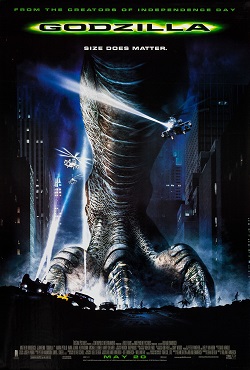
But as I was watching such movies as Independence Day (1996) and Godzilla (1998) (both from Roland Emmerich, coincidentally), I was stricken with the question of why such films, Godzilla in particular, should not make the list.
The giant monster subtype of horror/sci-fi is strange to consider. To modern audiences, the giant monsters of the 1950s (and before and since) are in general not particularly frightening. But that's not to say that they weren't scary to less experienced audiences who held rational fears of atomic radiation or simply were shocked by and unaccustomed to the spectacle of enormous monsters looming over the theater. In any case, while the subjective horror of these outdated, rubbery monsters is dispelled for contemporary viewers, the flavor of the horror film persists, and is unmistakable, even in these now-laughable selections.
Just because a film isn't particularly scary doesn't make it a non-horror film. So why does a movie like Godzilla fail to qualify? The answer I've devised is that for a film to qualify as horror, the frightening element must interrupt the narrative. By this, I mean that the underlying narrative that consciously directs plot and the audience must be temporarily broken by something that should feel dangerous.
Something that feels dangerous can be a monster, or it can be an event or action, like an attack, jump, or chase. It can also manifest as an unnerving situation or setting, which I think is what qualifies Eraserhead or A Clockwork Orange.
The underlying narrative is the progression of the plot. It is followed verbally or physically by the characters, and is tracked by the expectations of the audience. In The Wizard of Oz, the characters follow and continually make reference to The Yellow Brick Road, and the audience tracks that journey, such that each challenge faced by the heroes is met in reference to the ultimate goal, like an Odyssey or a series of Herculean Tasks. In contrast to this, we see horror characters frequently lost, confused, or stalled without alternatives. The Texas Chainsaw Massacre (1974) operates on the unnerving situation of five youths stranded nowhere, doing nothing, and unknowingly in terrible danger. TCM is the farthest thing from the Yellow Brick Road plot imaginable.
A movie like the 1998 Godzilla could have deployed its monsters as horror creatures, with a little tweaking, since they descend straight from the bloodline of King Kong and Jurassic Park, not to mention the Japanese originals, but they never transcend into horror because the narrative of the film is never interrupted by any of the dangers the film presents. The best examples come towards the end of the film, where the party of main characters is pursued alternatingly by the colossal Godzilla and by her man-sized, voracious hatchlings. A jeep evading a giant saurian and a party being chased on foot by hungry human-scale bipeds are both common to Jurassic Park and Godzilla, but whereas the dinosaurs in JP frequently deliver genuine scares that leave the protagonists reeling, the creatures in Godzilla, while behaving in almost identical fashion, are never met with the same kind of response by the protagonists. In this movie, the heroes are consistently approaching their plot goal when they are interrupted by a scary monster encounter. But instead of letting this intrusion generate horror by interrupting the narrative(screams and panic onscreen, screams and panic in the audience), the protagonists always have something to say in response, usually some kind of wisecrack. This maintains the intellectual composure of the characters, who manage to meet every threat head-on, internalize the danger, and dispense a comic rebuttal that connects the pre-intrusion to the post-intrusion. By this method, no character or audience member is ever reduced to, or intended to be reduced to, a real instinctive danger response. Instead of meeting the challenge instinctually, it is met verbally, which is simultaneous to the overcoming of the adversity.
A second, related point concerning violent interruptions of a film's narrative is that of non-horror films that could be horror films if the narrative itself were different. A film like Godzilla has a narrative that could be subject to horrific interruption, but is simply not so interrupted. Contrastingly, films like David Fincher's Zodiac and Fritz Lang's M are examples of films where the archetype of terror, in both cases the serial murderer, does not pose a threat to the narrative that the film follows. While Zodiac includes some horror-quality scenes, the narrative of the film is told through the lives and relationships of several characters involved in the Zodiac investigation. As such, that narrative is never threatened by the Zodiac killer, because the killer's actions are developed secondary to the development of the primary characters, who experience their own personal triumphs and tragedies, not in relation to the killer himself, but in relation to the mystery generated by the killings.
Similarly, M is an interesting film to watch today because in 1931, the vocabulary of filmmaking was very underdeveloped. Not many years before, things so taken for granted now like cutting between closeups of different faces during a conversation were completely alien, since such a seamless transition of perspective is not in any way a natural experience. The most noticeably underdeveloped piece of vocabulary in M is the unfocused narrative, which dwells for a long time on the explication of minor events, which might be summarized in a montage in a modern film. M gives ample screen time to all parties; the killer, the police, the underworld figures, the beggars, and scenes of the general public. By weaving such a broad narrative, Lang effectively narrates all of Berlin, to which the viewer is an observer. It creates an interesting story, but it is not crafted to make the audience invest sympathy in a narrative developed through a group of characters, like most modern films do. As such, the narrative of M is not even subjectable to such a threat as Peter Lorre's child-murdering character. It does not seem that there can be a "horror film" without such an interruption of the narrative.
Tuesday, April 19, 2011
Film Violence and Filmed Violence (and ethics)
Part I: Real Film Violence
A while back, I came upon a documentary titled Snuff (von Stoetzel, 2008)in Netflix's instant catalog. I approached this film with what I hold to be more than a morbid curiosity. My understanding had been that in general, the snuff film is an urban legend that continually captures the imaginations of paranoiacs and moviegoers. Immediately, the Cannibal Holocaust controversy, John Carpenter's Cigarette Burns for "Masters of Horror," and Season 2/Episode 13 of "Family Guy" come to mind. I expected to have the urban legend explanation reinforced.
When I was young, I was parented into the notion that there are some things you don't watch. I don't recall how explicit this doctrine was, but I do remember a lot of stuff being deemed inappropriate. I could tell you about my first M (for Mature) rated video game, my first R rated movie, and stuff of that nature, and I could tell you about all of the mystery these things held at the movie rental stores.
When I was in junior high/high school, videos of hostage beheadings started coming out of Iraq and finding their way immediately to the internet. I remember that at that time my parents upped our surfing filter protection.
Snuff includes, among other things, some of that footage. It is easily the most horrifying thing I've ever seen. I believe the footage therein is the murder of American Eugene Armstrong. One of his captors reads a statement before the camera, while Armstrong kneels hooded before him. Upon concluding his reading, the man produces a knife and begins to behead Armstrong. The cameraman rushes forward for a better shot as the leader saws vigorously at the right side of Armstrong's neck. The wound is obscured by the commotion, and thankfully, the documentarians fade away before the conclusion of the footage.
There is a difference between a cry of pain and one of real fear and disbelief. Pain is a common experience, but I don't think that actors can feign the real thing. That is what sticks with me most from watching that footage.
Part II: Real Violence and Ethics
I went through a recovery period for a few weeks after, straying from horror entirely and working out that persistent discomfort. I concluded that it was not unethical to have watched it. Likewise, there's nothing unethical about viewing the war footage in Snuff, the slaughterhouse footage in The Faces of Death, or the abortion footage in Lake of Fire. I don't believe in forbidden or evil knowledge, but I do think that it is possible to unethically recontextualize imagery that is otherwise neutral. For example, if any of the aforementioned films were marketed as pornography, there would be a much more substantial ethical quandary.
I think that "marketed" is a key word in this discussion, because it is at the heart of the central problem of this hypothetical. I am not comfortable with placing personal responsibility upon anyone for any fetish, paraphilia, or alternative sexuality, because in general, such attractions are not under rational control. So while I would condemn a pedophile who offends, I sympathize with what must be among the most excruciating afflictions.
While pedophilia is not a crime, the consumption of child pornography is, because it provides financial motivation for child abuse. This logic extends to "crush films" (the pornographic depiction of women stomping on small animals, recently in public controversy). The public outcry is not so logical; the attempted prohibition of crush films is motivated by the public's uncomfortability with the idea of killing animals for sexual gratification. Instead, I contend that the real problem is the killing of animals, and that while crush films are repugnant and ought to be outlawed, the same should apply to factory farming. Note that part of the rationale used in the preservation of freedom of speech rights for crush films is that wording such a prohibition would at the same time outlaw images depicting recreational hunting. I ask, how is one less wrong than the other?
Contextualizing an image in an ethical way is, I think, going to become an increasingly prevalent topic. I recently watched A Serbian Film (Spasojević, 2010), which probably represents the beginning of the real end of film ethics because of the extremely graphic subject matter. Even the word "graphic" suggests that the imagery is closer to the liberal end of the spectrum between disclosure and obfuscation. This film is beyond graphic, and does not shy away from showing what, to my knowledge, has not been filmed/created with special effects before. The envelope has been pushed almost as far as possible.
Here's why I think A Serbian Film is not unethical: That imagery is presented within a narrative context. The director claims his film is a political piece. I don't care if the allegory is apt or poor; it doesn't matter. It's a drama, not a porno or snuff film.
John Kenneth Muir reiterated one of his recurring points recently, arguing that mainstream horror films are usually the only mainstream films to consistently debate a moral universe. This post feels like a reminder that that moral universe is not just a hypothetical fiction.
Thursday, January 20, 2011
Black Swan- the split personality device
First, Darren Aronofsky's Black Swan is the finest film I've ever seen in a theater.
Second,this post discusses twist endings of a specific type, so beware of those spoilers.
One of my biggest pet peeves in the genre is the split personality twist. In Psycho, it was original. When I first saw Secret Window, I was blown away by the unexpected shift in the narration, which is a departure from Psycho. But many years and films later, and Secret Window pales. With the likes of Hide and Seek, High Tension, Identity, Fight Club, and Shutter Island all sharing the same territory, I really resent that twist at the end of a movie, especially if it's one I was really immersed in.
To me, the split personality twist is kind of a cop-out. It doesn't have a lot of root in reality, and yet it must be totally accepted on its face. It's too cookie-cutter for me. It doesn't do anything for the plot, generally, but is actually a huge step backwards at the conclusion of the film, where everything you invested in is revealed as immaterial. Therefore, if the director frames the plot like a mystery, and tries to cast suspicion on other characters, it turns out that those characters were acting strangely for no reason at all, and their conduct makes no sense.
And frankly, I'd hate it if I was watching John Wayne or Clint Eastwood get bullied for 90 minutes, and then at high noon he winds up standing in the middle of the street wearing a black hat and white hat stacked on top of one another.
In the split-personality film, there is one re-watch built in, where you find all the clues you missed before, and occassionally huge plot holes. After two viewings, the main value is to watch it with friends and see if they're surprised.
Black Swan manages to use the split personality without falling into any of the holes. And I thought these films were made in one big pit. But this film shows that it's possible to tread around the edges. This is accomplished in one huge way: the very careful disclosure of the split.
Black Swan works the surprise into the plot carefully, so that the film does not end upon the revelation of the split personality. Throughout the film, it is hinted that Portman's character is unstable, using cues, such as the moving face in the mother's painting studio, or the way that the mother does not acknowledge Mila Kunis' presence during the apartment confrontation. Other films often include elements like this, but they are intended to be discovered upon the second watching (for instance, the guard's promise of help to DiCaprio in the opening of Shutter Island). Black Swan cleverly employs the metastructure of Swan Lake to develop the split personality theme with enough directness that the audience should not remain oblivious to the parallel for long. And most importantly, when Portman's psychosis is ascertained, the film does not lose its focus. In a film like Secret Window or High Tension, the narrative revolves around the perspective of the sympathetic main character. Then, when that character goes mad in the third act, the audience must abandon that sympathy and abruptly embrace a different character, who we barely know.
Two alternatives emerge at that juncture. Either the former protagonist, who has gone mad, retains enough charisma to keep the audience's favor, as Johnny Depp was able to in Secret Window, or that character must remain, through a show of suffering and innocence, a sympathetic figure. In accomplishing this, Black Swan keeps the audience balanced between the intensity of experiencing Portman's frightening hallucinations in the first person and the third-person sympathy of watching her unravel.
Another improvement is the presentation of the cause of instability. Other films tend to give a very loose, flimsy reason for why the lead character has gone mad. High Tension: sexual attraction. Secret Window: a breakup. Identity: pre-existing madness. Pre-existing madness may be the worst, since it allows you to build the whole film on one phrase. The others feature ordinary people in ordinary situations, who for some reason suffer extraordinary psychological problems thereafter.
Black Swan devotes the entire film to developing an explanation for Portman's psychosis. This character development lends itself particularly well to film. Other stories that strive to provide a comprehensive backstory to a character often resort to a flimsy explanation scene, where a character details his past, or rely on flashbacks to childhood to pinpoint traumatic or formative experiences. Black Swan works well because the lead character's life is reasonably compressable to what the film reveals. Apparently, Portman's character has been dancing for most of her life, led into that life by her mother, the former ballerina. Her day-to-day has consistently been limited to spending long days with the company, and her nights with her mother. As such, her interaction with others has been primarily limited to the competitiveness and infighting of the dancers, dictated by the militaristic intensity the company and competition for roles, and the overbearing love of her guilt-tripping mother.
As such, Portman's character faces extreme stresses. The natural competitiveness of the ballet is exacerbated by the director, who dabbles haphazardly with the emotions of his dancers. At home, her mother puts out certain expectations while at the same time attempting to downplay those same expectations and remain optimistically realistic. But as many can attest, those do not cancel each other out.
And because her life as played out so rigidly, Portman's character is clearly socially inexperienced, as evidenced by her behavior around Kunis' outgoing character. It follows that she is sexually inexperienced, because she's never really had the time or opportunity to pursue anything of that nature (which is not to say she hasn't been taken advantage of, if we assume that she doesn't lie to the director when he asks about her about the subject). Additionally, ballet tends to postpone puberty in girls by eliminating the requisit body fat that triggers the changes in the body. As such, her repression is physical as well as emotional, creating total volatility. The cause of her psychosis is no mystery, and can credibly be summarized within the span of the film.
As a side note, the film is to some extent an allegory of delayed puberty. The character begins as childlike young woman. Her bedroom demonstrates that she has never abandoned the childhood she was given by her mother to develop an independent personality. Suddenly she becomes two people, nigh-literally. Her moods shift dramatically, she masturbates for the first time (unknowingly in the presence of her mother, no less), she becomes attracted to the older man, begins to have physical encounters, calls her sexuality into question, experiments with drugs and alcohol, and becomes resentful of her mother's best intentions and concerns. Upon everything else, this film highlights how truly bizarre puberty is, especially when taken out of context.
Subscribe to:
Posts (Atom)