Search This Blog

Saturday, June 18, 2011

Horror Must Interrupt the Narrative (When is a Monster Movie not a Horror Movie?)


In keeping track of the number of horror films I've seen, I am often confronted with the challenge of deciding whether a movie fits into the horror genre, or if I must exclude it from the list.

There are a few titles on there that maybe shouldn't be, and some that aren't that maybe should be. I'm currently a bit confused about Shaun of the Dead and The Frighteners; the former is listed, the latter is not. This raises the same question concerning other morbid comedies, including The Comedy of Terrors and Arsenic and Old Lace.

If any of my readership has an opinion on defining the genre with regards to such crossovers, I would appreciate the input in comments!


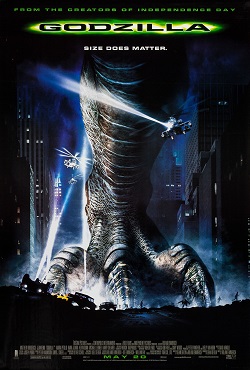
But as I was watching such movies as Independence Day (1996) and Godzilla (1998) (both from Roland Emmerich, coincidentally), I was stricken with the question of why such films, Godzilla in particular, should not make the list.

The giant monster subtype of horror/sci-fi is strange to consider. To modern audiences, the giant monsters of the 1950s (and before and since) are in general not particularly frightening. But that's not to say that they weren't scary to less experienced audiences who held rational fears of atomic radiation or simply were shocked by and unaccustomed to the spectacle of enormous monsters looming over the theater. In any case, while the subjective horror of these outdated, rubbery monsters is dispelled for contemporary viewers, the flavor of the horror film persists, and is unmistakable, even in these now-laughable selections.

Just because a film isn't particularly scary doesn't make it a non-horror film. So why does a movie like Godzilla fail to qualify? The answer I've devised is that for a film to qualify as horror, the frightening element must interrupt the narrative. By this, I mean that the underlying narrative that consciously directs plot and the audience must be temporarily broken by something that should feel dangerous.

Something that feels dangerous can be a monster, or it can be an event or action, like an attack, jump, or chase. It can also manifest as an unnerving situation or setting, which I think is what qualifies Eraserhead or A Clockwork Orange.

The underlying narrative is the progression of the plot. It is followed verbally or physically by the characters, and is tracked by the expectations of the audience. In The Wizard of Oz, the characters follow and continually make reference to The Yellow Brick Road, and the audience tracks that journey, such that each challenge faced by the heroes is met in reference to the ultimate goal, like an Odyssey or a series of Herculean Tasks. In contrast to this, we see horror characters frequently lost, confused, or stalled without alternatives. The Texas Chainsaw Massacre (1974) operates on the unnerving situation of five youths stranded nowhere, doing nothing, and unknowingly in terrible danger. TCM is the farthest thing from the Yellow Brick Road plot imaginable.

A movie like the 1998 Godzilla could have deployed its monsters as horror creatures, with a little tweaking, since they descend straight from the bloodline of King Kong and Jurassic Park, not to mention the Japanese originals, but they never transcend into horror because the narrative of the film is never interrupted by any of the dangers the film presents. The best examples come towards the end of the film, where the party of main characters is pursued alternatingly by the colossal Godzilla and by her man-sized, voracious hatchlings. A jeep evading a giant saurian and a party being chased on foot by hungry human-scale bipeds are both common to Jurassic Park and Godzilla, but whereas the dinosaurs in JP frequently deliver genuine scares that leave the protagonists reeling, the creatures in Godzilla, while behaving in almost identical fashion, are never met with the same kind of response by the protagonists. In this movie, the heroes are consistently approaching their plot goal when they are interrupted by a scary monster encounter. But instead of letting this intrusion generate horror by interrupting the narrative(screams and panic onscreen, screams and panic in the audience), the protagonists always have something to say in response, usually some kind of wisecrack. This maintains the intellectual composure of the characters, who manage to meet every threat head-on, internalize the danger, and dispense a comic rebuttal that connects the pre-intrusion to the post-intrusion. By this method, no character or audience member is ever reduced to, or intended to be reduced to, a real instinctive danger response. Instead of meeting the challenge instinctually, it is met verbally, which is simultaneous to the overcoming of the adversity.


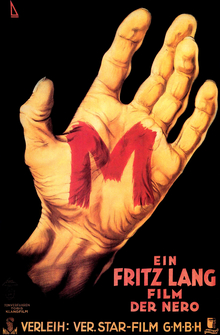
A second, related point concerning violent interruptions of a film's narrative is that of non-horror films that could be horror films if the narrative itself were different. A film like Godzilla has a narrative that could be subject to horrific interruption, but is simply not so interrupted. Contrastingly, films like David Fincher's Zodiac and Fritz Lang's M are examples of films where the archetype of terror, in both cases the serial murderer, does not pose a threat to the narrative that the film follows. While Zodiac includes some horror-quality scenes, the narrative of the film is told through the lives and relationships of several characters involved in the Zodiac investigation. As such, that narrative is never threatened by the Zodiac killer, because the killer's actions are developed secondary to the development of the primary characters, who experience their own personal triumphs and tragedies, not in relation to the killer himself, but in relation to the mystery generated by the killings.

Similarly, M is an interesting film to watch today because in 1931, the vocabulary of filmmaking was very underdeveloped. Not many years before, things so taken for granted now like cutting between closeups of different faces during a conversation were completely alien, since such a seamless transition of perspective is not in any way a natural experience. The most noticeably underdeveloped piece of vocabulary in M is the unfocused narrative, which dwells for a long time on the explication of minor events, which might be summarized in a montage in a modern film. M gives ample screen time to all parties; the killer, the police, the underworld figures, the beggars, and scenes of the general public. By weaving such a broad narrative, Lang effectively narrates all of Berlin, to which the viewer is an observer. It creates an interesting story, but it is not crafted to make the audience invest sympathy in a narrative developed through a group of characters, like most modern films do. As such, the narrative of M is not even subjectable to such a threat as Peter Lorre's child-murdering character. It does not seem that there can be a "horror film" without such an interruption of the narrative.

Tuesday, April 19, 2011

Film Violence and Filmed Violence (and ethics)


Part I: Real Film Violence

A while back, I came upon a documentary titled Snuff (von Stoetzel, 2008)in Netflix's instant catalog. I approached this film with what I hold to be more than a morbid curiosity. My understanding had been that in general, the snuff film is an urban legend that continually captures the imaginations of paranoiacs and moviegoers. Immediately, the Cannibal Holocaust controversy, John Carpenter's Cigarette Burns for "Masters of Horror," and Season 2/Episode 13 of "Family Guy" come to mind. I expected to have the urban legend explanation reinforced.

When I was young, I was parented into the notion that there are some things you don't watch. I don't recall how explicit this doctrine was, but I do remember a lot of stuff being deemed inappropriate. I could tell you about my first M (for Mature) rated video game, my first R rated movie, and stuff of that nature, and I could tell you about all of the mystery these things held at the movie rental stores.

When I was in junior high/high school, videos of hostage beheadings started coming out of Iraq and finding their way immediately to the internet. I remember that at that time my parents upped our surfing filter protection.

Snuff includes, among other things, some of that footage. It is easily the most horrifying thing I've ever seen. I believe the footage therein is the murder of American Eugene Armstrong. One of his captors reads a statement before the camera, while Armstrong kneels hooded before him. Upon concluding his reading, the man produces a knife and begins to behead Armstrong. The cameraman rushes forward for a better shot as the leader saws vigorously at the right side of Armstrong's neck. The wound is obscured by the commotion, and thankfully, the documentarians fade away before the conclusion of the footage.

There is a difference between a cry of pain and one of real fear and disbelief. Pain is a common experience, but I don't think that actors can feign the real thing. That is what sticks with me most from watching that footage.


Part II: Real Violence and Ethics

I went through a recovery period for a few weeks after, straying from horror entirely and working out that persistent discomfort. I concluded that it was not unethical to have watched it. Likewise, there's nothing unethical about viewing the war footage in Snuff, the slaughterhouse footage in The Faces of Death, or the abortion footage in Lake of Fire. I don't believe in forbidden or evil knowledge, but I do think that it is possible to unethically recontextualize imagery that is otherwise neutral. For example, if any of the aforementioned films were marketed as pornography, there would be a much more substantial ethical quandary.

I think that "marketed" is a key word in this discussion, because it is at the heart of the central problem of this hypothetical. I am not comfortable with placing personal responsibility upon anyone for any fetish, paraphilia, or alternative sexuality, because in general, such attractions are not under rational control. So while I would condemn a pedophile who offends, I sympathize with what must be among the most excruciating afflictions.

While pedophilia is not a crime, the consumption of child pornography is, because it provides financial motivation for child abuse. This logic extends to "crush films" (the pornographic depiction of women stomping on small animals, recently in public controversy). The public outcry is not so logical; the attempted prohibition of crush films is motivated by the public's uncomfortability with the idea of killing animals for sexual gratification. Instead, I contend that the real problem is the killing of animals, and that while crush films are repugnant and ought to be outlawed, the same should apply to factory farming. Note that part of the rationale used in the preservation of freedom of speech rights for crush films is that wording such a prohibition would at the same time outlaw images depicting recreational hunting. I ask, how is one less wrong than the other?

Contextualizing an image in an ethical way is, I think, going to become an increasingly prevalent topic. I recently watched A Serbian Film (Spasojević, 2010), which probably represents the beginning of the real end of film ethics because of the extremely graphic subject matter. Even the word "graphic" suggests that the imagery is closer to the liberal end of the spectrum between disclosure and obfuscation. This film is beyond graphic, and does not shy away from showing what, to my knowledge, has not been filmed/created with special effects before. The envelope has been pushed almost as far as possible.

Here's why I think A Serbian Film is not unethical: That imagery is presented within a narrative context. The director claims his film is a political piece. I don't care if the allegory is apt or poor; it doesn't matter. It's a drama, not a porno or snuff film.

John Kenneth Muir reiterated one of his recurring points recently, arguing that mainstream horror films are usually the only mainstream films to consistently debate a moral universe. This post feels like a reminder that that moral universe is not just a hypothetical fiction.

Thursday, January 20, 2011

Black Swan- the split personality device


First, Darren Aronofsky's Black Swan is the finest film I've ever seen in a theater.
Second,this post discusses twist endings of a specific type, so beware of those spoilers.

One of my biggest pet peeves in the genre is the split personality twist. In Psycho, it was original. When I first saw Secret Window, I was blown away by the unexpected shift in the narration, which is a departure from Psycho. But many years and films later, and Secret Window pales. With the likes of Hide and Seek, High Tension, Identity, Fight Club, and Shutter Island all sharing the same territory, I really resent that twist at the end of a movie, especially if it's one I was really immersed in.

To me, the split personality twist is kind of a cop-out. It doesn't have a lot of root in reality, and yet it must be totally accepted on its face. It's too cookie-cutter for me. It doesn't do anything for the plot, generally, but is actually a huge step backwards at the conclusion of the film, where everything you invested in is revealed as immaterial. Therefore, if the director frames the plot like a mystery, and tries to cast suspicion on other characters, it turns out that those characters were acting strangely for no reason at all, and their conduct makes no sense.

And frankly, I'd hate it if I was watching John Wayne or Clint Eastwood get bullied for 90 minutes, and then at high noon he winds up standing in the middle of the street wearing a black hat and white hat stacked on top of one another.

In the split-personality film, there is one re-watch built in, where you find all the clues you missed before, and occassionally huge plot holes. After two viewings, the main value is to watch it with friends and see if they're surprised.


Black Swan manages to use the split personality without falling into any of the holes. And I thought these films were made in one big pit. But this film shows that it's possible to tread around the edges. This is accomplished in one huge way: the very careful disclosure of the split.

Black Swan works the surprise into the plot carefully, so that the film does not end upon the revelation of the split personality. Throughout the film, it is hinted that Portman's character is unstable, using cues, such as the moving face in the mother's painting studio, or the way that the mother does not acknowledge Mila Kunis' presence during the apartment confrontation. Other films often include elements like this, but they are intended to be discovered upon the second watching (for instance, the guard's promise of help to DiCaprio in the opening of Shutter Island). Black Swan cleverly employs the metastructure of Swan Lake to develop the split personality theme with enough directness that the audience should not remain oblivious to the parallel for long. And most importantly, when Portman's psychosis is ascertained, the film does not lose its focus. In a film like Secret Window or High Tension, the narrative revolves around the perspective of the sympathetic main character. Then, when that character goes mad in the third act, the audience must abandon that sympathy and abruptly embrace a different character, who we barely know.

Two alternatives emerge at that juncture. Either the former protagonist, who has gone mad, retains enough charisma to keep the audience's favor, as Johnny Depp was able to in Secret Window, or that character must remain, through a show of suffering and innocence, a sympathetic figure. In accomplishing this, Black Swan keeps the audience balanced between the intensity of experiencing Portman's frightening hallucinations in the first person and the third-person sympathy of watching her unravel.

Another improvement is the presentation of the cause of instability. Other films tend to give a very loose, flimsy reason for why the lead character has gone mad. High Tension: sexual attraction. Secret Window: a breakup. Identity: pre-existing madness. Pre-existing madness may be the worst, since it allows you to build the whole film on one phrase. The others feature ordinary people in ordinary situations, who for some reason suffer extraordinary psychological problems thereafter.

Black Swan devotes the entire film to developing an explanation for Portman's psychosis. This character development lends itself particularly well to film. Other stories that strive to provide a comprehensive backstory to a character often resort to a flimsy explanation scene, where a character details his past, or rely on flashbacks to childhood to pinpoint traumatic or formative experiences. Black Swan works well because the lead character's life is reasonably compressable to what the film reveals. Apparently, Portman's character has been dancing for most of her life, led into that life by her mother, the former ballerina. Her day-to-day has consistently been limited to spending long days with the company, and her nights with her mother. As such, her interaction with others has been primarily limited to the competitiveness and infighting of the dancers, dictated by the militaristic intensity the company and competition for roles, and the overbearing love of her guilt-tripping mother.
As such, Portman's character faces extreme stresses. The natural competitiveness of the ballet is exacerbated by the director, who dabbles haphazardly with the emotions of his dancers. At home, her mother puts out certain expectations while at the same time attempting to downplay those same expectations and remain optimistically realistic. But as many can attest, those do not cancel each other out.
And because her life as played out so rigidly, Portman's character is clearly socially inexperienced, as evidenced by her behavior around Kunis' outgoing character. It follows that she is sexually inexperienced, because she's never really had the time or opportunity to pursue anything of that nature (which is not to say she hasn't been taken advantage of, if we assume that she doesn't lie to the director when he asks about her about the subject). Additionally, ballet tends to postpone puberty in girls by eliminating the requisit body fat that triggers the changes in the body. As such, her repression is physical as well as emotional, creating total volatility. The cause of her psychosis is no mystery, and can credibly be summarized within the span of the film.


As a side note, the film is to some extent an allegory of delayed puberty. The character begins as childlike young woman. Her bedroom demonstrates that she has never abandoned the childhood she was given by her mother to develop an independent personality. Suddenly she becomes two people, nigh-literally. Her moods shift dramatically, she masturbates for the first time (unknowingly in the presence of her mother, no less), she becomes attracted to the older man, begins to have physical encounters, calls her sexuality into question, experiments with drugs and alcohol, and becomes resentful of her mother's best intentions and concerns. Upon everything else, this film highlights how truly bizarre puberty is, especially when taken out of context.

Tuesday, November 16, 2010

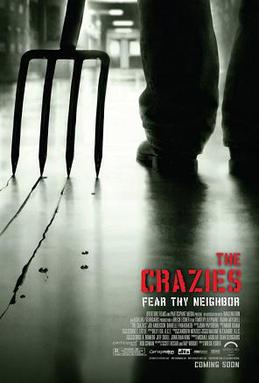
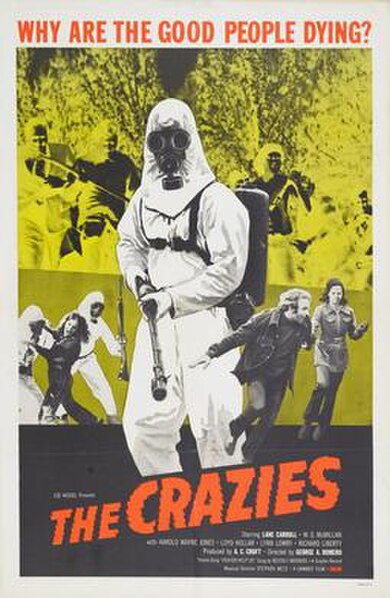
The Crazies (2010): Conservative horror?


I was entertained by Breck Eisner's remake of George Romero's 1973 The Crazies, but I ultimately didn't care much for it.

Less consequentially, I think it suffers from being a good idea lacking in follow-through. I occasionally accuse sci-fi plots of starting with a good concept that gets dropped along the way. For example, I felt that Tony Scott's Déjà Vu had a pretty interesting time travel thesis going on, until it got dropped for explosions and an obligatory romance plot. The Crazies keeps Romero's concept of a virus that induces a murderous frenzy. In the original film, this creates rabidly violent victims, not unlike the experimental combat drug in Jacob's Ladder (1990). Eisner departs from this mold by allowing the infected to retain their composure, so that the virus compromises something else. Perhaps it creates paranoid delusions? For whatever reason, the film departs from its pseudo-zombie movie predecessor, giving us calculating killers instead of mindless hordes.
And that'd be fine, except that it is later shown that the infected are capable of setting traps and working as teams. Now, zombies don't kill one another, because they only hunt the living, and their compatriots are dead by definition. But why wouldn't the infected in this film attack one another? And go as far as to establish camaraderie?


Anyway, we're pretty well familiar with hippie horror as a liberal institution, if you elect to read Romero's original film as part of post-Vietnam disillusionment and a critique of government and military. So now it kind of makes sense that the new American radicals, conservatives and Tea Partiers, take up the same protest imagery to convey their impressions of "big government."
Liberal horror, when it addresses government and military, tends to criticize how America treats the outsider, calling upon injustices of foreign wars and general xenophobia. Romero's The Crazies comments on the American war practices against the Vietnamese, as well as the treatment of American soldiers as expendable. That film shows the tables turned, as the military is deployed against its own citizens, and even features a self-immolation, referencing the powerful imagery of Vietnam-era protest.
Liberal antiwar protest always seems to target an individual character, calling out the president on "war crimes" or what have you, and staking a hope for reform on the ousting of this specific character. The 1973 film gives faces to the politicians and military leaders responsible for the catastrophe, which demonstrates a belief in personal responsibility and accountability. This isn't particularly noteworthy until we consider the remake.

The 2010 version of The Crazies portrays the government in the absolutely most negative possible light. As an entity, the leadership remains entirely faceless, but we are able to see through its eyes by way of "big brother" spy satellites, which zoom in to the action on the ground periodically. This imagery is very similar to the telescope view used by the mutants in the remake of The Hills Have Eyes, which shows the stranded family as always being watched by their stalkers and murderers.
This is where I see a libertarian bent to this film: The government is portrayed as a malevolent entity, not as something human, accountable, and reparable. You can't vote those spying eyes out of office.
Counter to the faceless government and its faceless gasmasked drones are the regular, ordinary folks, led by the small-town sheriff, who would be capable of seeing after themselves if it wasn't for big brother's interference.
The selection of school and hospital as key battlegrounds comments on the political struggle for the control of these institutions. In the remake, the school is repurposed as detention center/hospital. The public school system has always been a contentious topic, but the hospital is relatively new, perhaps serving as a commentary on "Obamacare." We see that in this hospital, everyone is treated the same. The infected are strapped down alongside the healthy, because the authorities aren't interested in sorting through the patients. It is later revealed that those who were quarantined and the others who were shipped out met the same fate either way. Sound like "death panels" to anyone?
Finally, I think the "crazies" themselves have a political role to play. The characters are not portrayed particularly sympathetically. I think it would be fair to interpret the crazies as the political opposition to the central "conservative" characters. After all, it is technically the fault of the infected that the big bad government invaded the town to deal with the situation created by rampant psychosis, which of course, was created by the government when it leaked a toxin into the water supply. Compare this to an image of American social programs where the government has to clean up, for example, the homelessness problem, at the expense of the taxpayers, to solve a problem that the government helped to create in the first place.
At one point in the film, the infected become the arm of government agenda. In scene where the restrained patients in the hospital are systematically skewered by a crazy with a pitchfork, let's remember that it's essentially the fault of the government, first for not posting any security in this wing of the building, and secondly, because this maniac is achieving the same goal the military personel were going to carry out anyway. As in, when socialized medicine takes away your doctor and forces you to see someone else, the pitchfork man is the new doctor you can't trust, who kills you in your bed along with everyone else because you can no longer get the treatment you need.


Did anyone else get this vibe?

Saturday, November 13, 2010

Flower of Flesh and Blood, ethics, and the ontology of the body


Guinea Pig 2: Flower of Flesh and Blood (1985)- if you're not trying to do something academic with it, there's absolutely no reason to watch this movie, beyond satisfying a curiosity.
My friend Kara posted a comment on an older post, asking how exploitation fits into a definition of the horror film, and citing the Guinea Pig series as a possible example of pure exploitation.
I had never heard of this film. Perhaps you haven't either.

Synopsis
The film begins with a man chasing and choloroforming a young woman. When she awakens, she is bound to a bed in a bloodied basement. He beheads a live chicken and says something to the effect of "This will be you!" He then drugs her, and explains to the camera that she now feels no pain, and perhaps even feels pleasure. Then, using various implements, and in great detail, he dismembers her. In between amputations, he describes the body poetically, building on the theme of a "flower of flesh and blood."
When he is finished, he explains that he is adding her to his collection, and pulls back a curtain to reveal an area where he embalms some body parts and composts others.
Famously, actor Charlie Sheen, believing the movie to be a snuff film, contacted the MPAA, who contacted the FBI.
The entire runtime is about 40 minutes.

Observations
This film is very unusual, and defies a lot of expectations. With it's reputation in mind, I fully anticipated the possibility of having to turn it off for being revolting or offensive. Instead, I noticed that my heart rate did not accelerate at any point during the film, not because of some desensitization, but because of the very unusual presentation of violence.
The early scene where the captor threatens his victim by beheading the chicken is kind of an anomaly, for he does not otherwise seem to wish her any ill will. By drugging her, he ensures that she will feel no pain. The film therefore is extremely light on sadism and suffering. Compared to The Last House on the Left and Irréversible, two films that will always stand out to me for provoking strong reactions, Flower of Flesh and Blood is in some ways much easier to watch. It reminds one of surgical television programs, with a lot of gore narrated in serious tones. Because there is a lack of suffering or sadism, there is no suspense. For the majority of the film, the stakes are very low. Sure, she gets murdered. But painlessly? Not a bad way to go.

Perspective on the body
Occasionally, I happen into a weird perspective of what the body is. It cropped up a while back in another blog in a debate about teleportation, where I argued a perspective that comes from trying to describe the body in as "realistic" a way possible, removing the identity and considering the constituent elements. Sometimes a film can put you in touch with this distanced perspective. A scene from Tony Kaye's documentary Lake of Fire shows a doctor concluding an abortion by taking stock of the excised tissues. The footage is unsettling, but I found that it affirmed my belief in the right to choose. Abortion highlights the ontological problem of staring into the doctor's dish and describing what you see. It is somehow both a person and a conglomeration of tissues. The two impressions compete, and inform our ethics. In that tiny, disarrayed body, we can see something vile and wrong, but we can also see the wonders and curiosities of the chaos of biology.
Despite the fact that you are your mother's child, you may find yourself awakened to the fact that the raw materials of your body have always been the raw materials of something else, perhaps as one-time parts of innumerable other living things, and before that, they hurtled through space as stardust. At a distance, your body is composed of the same heterogeneous clay that forms everything else.
If we let this perspective compete with our ethics, we can explore Flower of Flesh and Blood. Surely it is wrong to murder, but beyond that, is it wrong to marvel at the body as one would appreciate a flower? Is it immoral to admire the way that blood blooms from a wound, to sniff the heavy bouquet of decay, or taste human blood, simply for the sake of experience?
In the murderer, Flower of Flesh and Blood presents an interesting study in motivation. By my interpretation, the murderer kills not because he wishes to murder, but because murder is an incidental prerequisite to his actual goal, which is to commune with the living body freely. Somehow, he blurs the boundaries of psychopath, naturalist, pervert, and transcendentalist poet.
This mirrors Patrick Süskind's novel from the same year (1985) Perfume: The Story of a Murderer, which was adapted to film in 2006 by director Tom Tykwer. The lead character, Jean-Baptiste Grenouille, is born with a superhuman sense of smell, and no scent of his own. He learns the perfuming trade, and endeavors to craft the perfect scent from the essence of virginal women. His experience of these women is sensual and exploratory, and totally divorced from the ethics of committing murder.
Flower of Flesh and Blood bears another interesting relevance to real events. Jeffrey Dahmer once gave an interview where he detailed the drives and desires that pushed him to commit his crimes. He expressed great regret and discussed hating having to murder on the way to satisfying those drives. The complexity of the pathology evokes some sympathy, as we see a man who killed not out of greed or a disregard for human life, but because he was coerced by some curious sickness, perhaps indeed a sickness of curiosity.

Exploitation
In response to Kara's question, I believe that this film is not an example of "pure exploitation." The exploitation film draws its audience by exploiting a specific interest the audience holds. This works like a form of advertising. For example, the "blaxploitation" films of the 1970s were produced specifically for black audiences. Exploitation is a method to get people into the theater. Pornography is another exploitation genre that exploits a certain (obvious) interest. The Guinea Pig series is exploitation aimed at the facet of horror fandom compelled by graphic depictions of gore. But is there such a thing as "pure exploitation?" I think that a film's content is separate from its exploitation techniques, which I would describe as "meta-content." That its content is particularly relevant to x audience population is irrelevant to the film's ability to stand on its own, and to be judged for better or for worse by its merits. Therefore, the film that is "pure exploitation" would necessarily be one that doesn't exist, but is nonetheless advertised! It could be well-argued that the "Royal Nonesuch" show from Twain's The Adventures of Huckleberry Finn could qualify, a near non-event that continues solely because of the patrons' desire to see their friends and neighbors similarly conned!

Not to give too much credit...
For 40-odd minutes of monotonous carnage, Flower of Flesh and Blood somehow yielded a lot to discuss. But it is not my intention to find merits where they shouldn't be found. Learning about biology from studying roadkill isn't a reason to laud the careless driver that ran it over. The film has some interesting sub-text, but it always borders on the faux-philosophical edge of bad filmmaking. Just because the film has something to do with the aesthetics of murder doesn't make it Se7en. The film reveals the intent behind it by bending to some of the more distasteful genre conventions, to the detriment of anything worthwhile therein. Already mentioned is the chicken scene, a preposterous attempt to create suspense. Furthermore, and quite egregiously, the eventual beheading scene is undertaken in slow-motion, and the head adopts a laughable and wholly unrealistic trajectory, splatting against the wall dramatically. This is very poor filmmaking with a marginal element of luck.

Gore can be fun. Consider any of makeup artist Tom Savini's work: there's always an element of good-natured joviality in each instance of "Wow!/Gross!" His hard work pays off, and it's clear that the crew had a good time putting that moment together, compared to the film in question, which reeks of unpleasantness.
You could watch this movie on a dare, but don't expect to be entertained.

Friday, November 12, 2010

Soraya M. and a new definition of horror


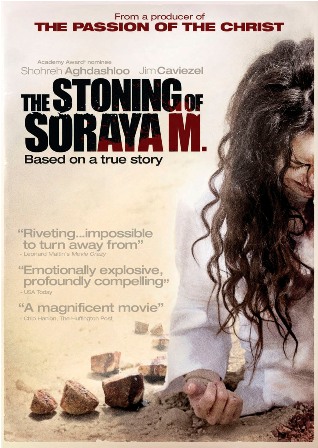
On a professor's recommendation, I sought out The Stoning of Soraya M. (2008), a dramatization of Freidoune Sahebjam's 1990 novel La Femme Lapidée, based on a true story.

This film presented me with a problem. As I have mentioned previously, I maintain a list of horror films I have seen. Keeping this list raises questions of what films qualify for genre classification. A previous post discusses my mode of definition. In that discussion, I decided that the central requirement of the horror film is that it horrifies the viewer.

When Soraya M. was finished, I faced a conflict of whether to include it as a horror film on my list. On the one hand, the film was certainly horrifying. It tells the true story of a woman vicitimized by a conspiracy to abuse Islamic law in 1986 Iran. Part of me felt that categorizing the film as horror cheapened the real-life tragedy behind it. This aroused a concern that I may be harboring a prejudice that horror is inherently cheap, which compromises the integrity of this blog.

It appears that the classification of this film will be the ground upon which I must again discover and defend my disposition towards this genre.

The Story
The Stoning of Soraya M. has a lot in common with The Stepford Wives (1975). Stepford centers on two women banded together to modernize their position in their male-dominated community. These women uncover a plot by the men in the community to murder their wives and replace them with animatronic slaves.
Soraya and her aunt are a similar pairing working towards a similar goal. The aunt uses her good standing with the men of the community to protect Soraya, finding her a job looking after the home of a widower. The aunt uncovers a similar murder/replacement plot, here with the men spreading a rumor of adultery, so that Soraya can be executed under Sharia law, leaving her husband free to marry a young girl.

It is somewhat uncomfortable to say that The Stoning of Soraya M. and The Stepford Wives have similar "plots." It seems offensive to the memory of the real Soraya and other victims of oppression. Still, in a vacuum, both films tell similar stories.

Why Now?
One standard question that pops up when reviewing films is "Why now?" When the source material is not contemporary, it helps to ask what is so relevant about the story to warrant attention today. What anxiety or sense of injustice does this film appeal to?
Just to deal with cynicism quickly, it should be noted that Sahebjam, the novel's author, died in March 2008. This film of his most famous work was produced in 2008 and released in March of 2009. Barring a great coincidence, the filmmakers could have used Sahebjam's temporary resurgence into the public consciousness as free publicity, with his passing as an impetus to produce this film quickly. Less cynically, one could view the film as a tribute to the life of the author, though I'm not convinced the industry often works that way.

Considering the actual stoning as a civil rights issue, the film is not necessarily a call to outrage over the death of this individual. When the film was realeased, Soraya Manutchehri had been dead for 23 years, and Sahebjam's novel had broken the story 19 years prior. Rather, the film seems to be part of the West's attack on Islamic culture.

It is not my place to weigh in on the civil rights of women under Islam, but the foremost criticism in recent years has been against the burqa, as a symbol of the oppression of women. But to me, it seems that outrage over the burqa is just another path to attack Islam itself.
The film concerns religious law, and how it can be abused to horrible effect. But the film doesn't just criticize the law and the men who twist it. It targets Islam as the culprit, and portrays the faithful in a very negative light, not unlike cultists of the horror canon (compare the mob's cries of "God is great!" to the "Hail Satan!" of Rosemary's Baby). In fact, by the end of the film, the women are almost secular characters. Soraya never invokes God in the scenes leading to her death. Instead, she appeals to her aunt to keep her memory alive, which is the closest thing to a secular afterlife. Soraya's apparent lack of faith seems purposeful. Having her invoke God before her execution would have been the classic opportunity to differentiate moderate Islam from fundamentalism, but instead, the film has nothing good to say about the faith at all.
Furthermore, I am made suspicious by the cover of the film, which proclaims "From the producers of The Passion of the Christ. I suspect that the audience targeted by this credential is an audience that is looking to have their fears of Islam reinforced.

Figures of Myth
To counter my worry that it is disrespectful to address a factual story like a fiction, I look to other films that should raise the same quandry. There are many dramatic films that rely upon factual misfortunes, but in those films, the characters are mythologized. It could be argued that the way a historical person is mythologized into a character is essential to human culture. They become the malleable elements of oral history. In the same way that George Washington was remade into a paragon of honesty, or how Ed Gein has been repurposed into many a glorified campfire story, Soraya Manutchehri has been transformed from a victim to a martyr, and, if my analysis is credible, perhaps into a weapon against her own faith.
I conclude then that the burden of classification in these films falls to the filmmaker, and where I may recognize an intent to horrify, I am justified.

A New Tripartite Definition of Horror
There are three senses of horrified. The most common form is the experience form, like riding a rollercoster, or a jump-scene in a scary movie that tricks you for a moment into believing that your are in actual danger. The second form is experience-emotional, which uses the experience of the film to draw you in, where that emotional investment brings you in touch with some greater anxiety (for example, the audience's committment to Alex is essential to the realization of the dystopic horror of A Clockwork Orange. The third sense of horrified, simple emotional horror, does not apply to the horror film. This is witnessing the horrific without the distance of the movie screen. News footage or a snuff film could never qualify for the genre.
The Stoning of Soraya M., because it is a dramatization, cannot be the authentic, third sense of horror. Regardless of how accurate it may be, it will always be a movie, an image crafted to evoke an effect. Because I was horrified, I recognize it as a horror film. When I sat down to compose this, I intended to explain why the film was not horror. But I've convinced myself otherwise, and have added it to the list at #289.


P.S.
1. The execution sequence is truly horrific, more on par with The Passion of the Christ than with the typical execution scene in other dramas, which always seem to keep their distance and minimize the graphic depictions of suffering. In contrast, Soraya M. horrifies by drawing out the sequence, embellishing the throwing of each stone, and even employing a first-person perspective. This film is about the horror of this scene, unlike the memorable and affecting hangings of Capote which are nonetheless incidental to the greater story.

2. The titling of this film follows a trend noted in John Kenneth Muir's Horror Films of the 1970s. Many '70s horror titles were formulated as "The (some happening) of (proper noun), with a distinct rhythm to the phrase. This began with the like of The Reincarnation of Peter Proud and The Possession of Joel Delaney, and can be found more recently in The Exorcism of Emily Rose, The Haunting of Molly Hartley, and The Possession of David O'Reilly.
Not that it was necessarily intentional, but The Stoning of Soraya M. follows the pattern.

Tuesday, October 5, 2010

Irréversible- impressions


When I report that Irréversible is the new most violent movie I've seen, keep in mind that my tally of horror films has hit 271. That's a lot of precedent to overcome. I did not know what I was getting into.

Setup
The film is presented completely backwards, like Memento, which presents an unusual problem for someone trying not to give away the ending (beginning?). So here's the essentials in chronological order, spoiling the film.

Alex, her boyfriend Marcus, and her ex-lover Pierre are at a party.
Alex leaves and is brutally raped and battered by The Tenia in an agonizing 9-minute single camera scene.
Marcus seeks revenge, while Pierre acts as the voice of reason.
The pair make their way to a gay SM nightclub to confront The Tenia. Marcus mistakenly fights with another man, who breaks his arm and attempts to rape him.
Pierre steps in to defend Marcus, literally reducing the man's face to its constituent elements with a fire extinguisher while the club's patrons watch.
Pierre is arrested, and Marcus is taken to the hospital.

The above describes the first half of the film. The reverse chronology continues back to the hours before the party, giving insight into the relationship between Marcus and Alex, and her past relationship with Pierre.

Who is The Tenia?
The Tenia is remarkable in that his sexuality is not categorizable. He is described as a pimp and seen in the company of a transgendered prostitute. In the club, he appears to be a patron, but commands the respect of the others, and is shown sniffing amyl nitrates casually at the edges of the larger crowd.
That he rapes Alex presents a paradox. By all indications, he is a homosexual, and even comments during the assault "I don't usually like this." His preference for anal intercourse could indicate an underlying aversion to the female body.
It is my contention, however, that The Tenia does not have a sexuality, homosexual, bisexual, or otherwise. Instead, he is attracted to and satisfied by the infliction of pain and the exercise of his own power over others. His sexual preferences are tied to narcissim and sociopathy. The gender of his target is irrelevant. He displays the same violence towards all with an apparent erotic satisfaction as he asserts himself.

Marcus vs. The Tenia
The Tenia is the most obvious clue to the greater scheme of the film. He is a caricature of beastly instinct, the bare bones of the erotic drive stripped of all empathy. He is the obvious villain, and Marcus is his counterpart.
If The Tenia is the embodiment of pure, cruel instinct, Marcus is only one short step better. He has been socialized into morality, but still lacks inhibition. At the chronological beginning of the film, Marcus' relationship to Alex is shown to be primarily a carnal one. Marcus may be incapable of contributing any other kind of emotional satisfaction besides his playful goodnaturedness. He is bad with money, prone to blurting his sexual desires out of context, and resentful of Alex's continued friendship with Pierre. At the party, he casually uses hard drugs, lies about it, kisses random women, completely disregards Pierre's personal boundaries, and patently ignores all attempts to reign him in. His behavior at the party, bouncing around chaotically, is telling of his larger role: he lacks self-control and introspection, and though his disposition is benign if not amusing, he still has the potential to cause harm.
What separates Marcus and The Tenia is a veneer of civility. The unreigned freespiritedness that attracts Alex to Marcus is akin to the charismatic brutality that makes The Tenia a respected figure among his crowd.

Alex and Pierre
Alex represents the ideal balance between instinct and restraint. She exercises her instinct in the proper venue, relaxing her inhibitions and dancing at the party without giving in to Dionysian debauchery. She has a healthy sex life that gives her satisfaction and enables her to satisfy her partner, and is able to reflect articulately about that aspect of herself.
On the continuum of instinct/restraint, Pierre falls too far into the side of restraint. He is a philosophy professor, and his academic background isolates him from the other characters, who dismiss his attempts to bring rationality to the events of the evening. It is revealed that his relationship with Alex failed in part because he was unable to satisfy her sexually, which is attributed to his overthinking the process and never letting his instinct take over. Though he tries to hide it, he shows himself to be the lonely ex-boyfriend. His friendship with Alex is slightly overbearing, but he attempts serve her best interests, thinking that to be the right thing to do, rather than give in to jealousy, and tries to control the unpredictable Marcus.
Pierre's self-control is a form of repression, and his instinctual side boils below the surface. His participation in the quest for revenge overtly appears to be an attempt to protect Marcus, but it is likely that he could not turn away from the increasingly outrageous circumstances because he subconsciously desired revenge.
Finally, his repression fails when he is called to protect Marcus in the club, and he strikes Marcus' attacker. The necessity of protecting Marcus having passed, the fully rational man should be able to walk away. But in erroneously believing this man to be the rapist, his repressed love for Alex explodes forth, and in a stomach-turning, soul-killing triumph of film technique, he continues to beat the prone man long past the point of actually killing him. His efforts to continue doing so are labored, much like Pitt's finale performance in Se7en, with the rage in him barely trumping his better judgment. The violence spills out of Pierre at irregular intervals, like great physical sobs coming from a man who can no longer maintain his composure.


Irréversible is remarkable in that it is fundamentally an examination of humanity that does not shy away from anything. Though the camerawork is highly creative, the subject matter is honest and unstylized. It captures the prolonged agony of violence without editing it down to something palatable. The film received great scorn for its depiction of violence against women, but I find it more ethically responsible to fully express the cruelty rather than edit it down into the bare minimum excuse for the exercise of revenge-narrative machismo. By telling the story in reverse, the film insures itself against becoming Straw Dogs or The Last House on the Left.

If Antichrist is the exploration of the violent fundamentals of human eroticism through psychology, Irréversible is its anthropological counterpart. In Antichrist, the self-psychologizing of the characters lays the groundwork for future violence. In Irréversible, the violence is shown first, and its explanation is given through studying the behavior of the characters.