Search This Blog

Monday, July 26, 2010

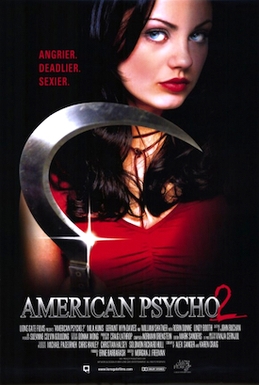
American Psycho 2: Shut up, Meg


The relationship between this sequel and its predecessor is flawed. American Psycho 2 would likely be a better film if it weren't for American Psycho. For the record, the 2000 original is one of my favorite films. Out of context, the dialogue is very distinctive. It is dark, narcissistic, edgy, and often hilarious. In context, it creates an atmosphere where Bateman's insanity is indistinguishable from the backdrop of 1980s superficiality.

Very few people involved in the sequal noticeably give a damn about the original. But as "Brian," Robin Dunne delivers his lines like he belongs in a junior version of the American Psycho world. Frankly, I really appreciate that. This film could not have disappointed me, because I had zero expectations. I wish that as long as these films shared a title, more of the writing and acting could have played along.

For instance, Mila Kunis' narrative segments could have bounced between exceedingly blase and seething intensity, as Christian Bale did as Patrick Bateman. Or Kunis could have composed something unique to subtly indicate her mental disturbance. Unfortunately, I kept hearing Meg Griffin's voice from "Family Guy" and responded the way Seth MacFarlane has conditioned me to.

Except Kunis' character can't afford to have a tell, because in order to hide her crimes, she has to blend in as a typical teen (Yeah, teen. Not many college freshmen can order drinks on a date). The most wonderful aspect of American Psycho is that though Bateman can hardly conceal his madness, his slips go unnoticed in a mad world.

Additionally, it is my contention that the violence perpetrated in American Psycho does not occur in the real-life narrative. Rather, these are fantasies had by a man who has no other way to relate to others. Bateman has no real relationships with other people. He works and plays with the same group, but they are certainly not friends. Thus they are reducible to obstacles and entertainment objects. Like most anyone else, his ability to hate others is not proportionate to his knowing them.

Patrick Bateman is a man in a perpetual state of road rage, but rather than honk and curse, he engages in a violent fantasy. The fantasy alone is innocuous, but the confession at the end of the film could indicate the dissatisfaction and loneliness of a man starved for human contact that is not mediated by superficiality and self-centeredness.

American Psycho 2 invalidates the above theorizing by firmly establishing Bateman as a serial killer. But if that were the simple truth, nothing about the first film would be nearly as interesting. Not to say that the sequel isn't entertaining, but it does not really inherit the legacy of the original in the way a sequel ought to.

Friday, July 2, 2010

Wait Until Dark, and films based on plays

It's time to pay respect to my all-time favorite film, Wait Until Dark, directed by Terence Young from 1967. This picture stars Audrey Hepburn as a blind woman unknowingly in possession of a doll filled with heroin. Trying to locate the doll are three criminals, played by Alan Arkin, Richard Crenna, and Jack Weston. These men devise and perform an elaborate con to gain access to the apartment and talk their way to the doll. The film builds to a harrowing climax which takes place in total blackness (the theatrical run carried a warning that the theater was to be darkened to the legal minimum lighting for this scene).

I absolutely love everything about this movie. The performances are captivating and the plot is intricate and detailed. But what I can identify as its greatest asset is the dialogue. Wait Until Dark was adapted from a play written by Frederick Knott, so the task of sorting out what does and doesn't work in the plot had already been tested on live audiences. This results in a finely-tuned film that conserves its resources. The plot is totally dialogue driven, and is supported by visual cues. This style of screenwriting doesn't show up much anymore. It's tough to keep dialogue interesting.

The Big Sleep (1946) comes to mind, where Raymond Chandler's book was adapted as a film that sounded a lot like a book on tape. It's embarrassing to admit to being bored by a classic, but I think we've come away from that mode of storytelling in film for good reason. Wait Until Dark isn't wordy, but it somehow manages to develop its intensity through verbal exchanges, without relying on anything too over-the-top. That makes it lifelike.


Years ago, I started listening to movies to fall asleep (any music keeps me awake). I eventually moved on to old time radio programs from archive.org (which I can't recommend enough), but ever since I have heard Wait Until Dark dozens of times. This film has a lot in common with radio dramas, because it's quite possible to enjoy the film without any visual aid. I discovered this when I tried to let Psycho run at bedtime and was awakened in the most horrible panic a third of the way through, every night. Changing over to Wait Until Dark was a good choice.

I typically enjoy films based on plays, because the director recognizes that he has serviceable material on his hands and tends to approach it with respect, so we end up with everything great about the original, plus very tasteful film-only additions, like fully-imagined sets and evocative music. Other films in this style that I can recommend include Arsenic and Old Lace (1944) and Dial M for Murder (1954, also written by Knott).

Wednesday, June 30, 2010

"Body horror" and dualism


I promise this post discusses horror films. Please be patient with the exposition.

Dualism

Think about your body. There. We've already proven the point I'm intending to make. You thought "my body." My body.

Let's draw out what makes this phrase suspect. If you are a religious person, you may believe in the soul, a god-given ego. If you are "of a secular mind," you may believe in the mind, another suspicious term. The idea of a dualism between mind and body is old and well-trodden. Philosophers of mind who wish to do away with the notion of the mind attempt to reduce it to functions of the brain. Others endorse the mind and rebuff reductionistic treatments of its mystery.

Regardless of what you believe about the mind or the soul (henceforth called the ego), our culture has 99.9% given in to dualism.

We are divorced from our bodies, and it is evident in our language and behavior. Myriad examples reveal this. We think of our bodies as the chariots of our egos. What is sickness? It is an affliction of our vessel. The naming of disease helps this process by creating distance from which we can address our afflictions. Sometimes the body grows in a self-destructive way. We have a phrase for this: getting cancer. We draw a sharp distinction between ourselves and the part of ourselves that we recognize as a threat. We can easily excise bits of ourselves when they don't suit the project of continually housing the ego in the body.

Perspectives on pregnancy fit this framework. Pro-choice interprets a pregnancy as an outside influence on the mother's body. Abortion is a cure for being afflicted with pregnancy. Pro-life is no different, where the fetus is a visitor to the mother's body to be safeguarded. The fetus is a stranger, something not an extension of, but different from, the body of the mother. Neither perspective is truly a bodily perspective; both are plays at forcing the body to submit to the ego.

Skin versus Flesh

I cannot speak to your experience, but "skin" is a very different word to me than "flesh." Skin has so many uses and meanings, while flesh is a charged word that evokes a sense of revulsion in me.

The colloquial phrase "pleasures of the flesh" speaks to bodily experience and all methods of living through the body, often by way of consuming other bodies. Eating, whether it be plant or animal flesh, is the assimilation of flesh from one body to another, lived entirely in the first person, not with the third-person detachment of the ego. Nonliterally (but still quite literally), sexual intercourse is much the same, as another consumption of flesh, a bodily pleasure derived from assimilation.

But there is another aspect of sexuality, the inability to live it bodily. This is the sexual fetish, which reduces flesh to skin. Skin is a surface, a mental object. Some skin is flesh, to be sure, but other skin no more material than the clothing or makeup it bears. Flesh is the object of bodily experience, but skin is the object of mental desire.

Fetishizing the skin is an intrusion into the bodily experience of the flesh. The sexual fetish makes the partner the object of mental desire, an object cast in skin. The ego then sets about to manipulate the partner's body like a tool, contorting, restricting, and adorning it to satisfy aesthetic requirements, binding or covering the body to modify its shape, or enlarging (perceptually) the foot or the breast.

Bodies are already skin before our egos, though. Modifying our skin, we can change anything outward about ourselves. But flesh refers to something inward.

Filmed Bodies

How does film treat our bodies? Usually, film treats the body as a skin. As a visual medium, it may be impossible to treat the flesh. Any filmed scene is essentially a fetishized experience of the body. There is nothing fleshly about pornography. Filming pornography is another mode of recrafting the body to make it satisfying to the ego. The fleshly encounter of authentic violence, of actual moving through another's flesh, is reduced to an aesthetic skin in film; the idea of the body is recrafted by the knife or the bullet. Hordes of skin-bodies are remade as aesthetic objects in any action flick, cut down in waves to satisfy the demand of the viewer that they visually transition from "alive" to "dead," whatever those terms mean. There is something pornographic to this.

Body Horror

What does "body horror" do in this framework? Body horror is understood as fiction dealing with deformed and deforming bodies. David Cronenberg is the director most closely identified with this subgenre.

Following my exposition above, I require that authentic "body horror" portray the deformation of the body in question sympathetically. That is to say, I include, for example, Cronenberg's The Fly but not Carpenter's The Thing, because the Thing's malformed flesh is always inhuman, only resembling the human figure.

I suggest that body horror offers a special interaction with the dualism of ego and body, specifically that it at once recovers a sense of the flesh while simultaneously obscuring it.

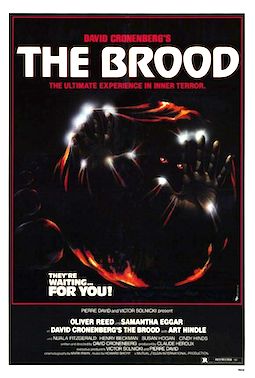
Cronenberg's 1979 film The Brood is an example of the recovery of flesh in body horror. In the film, a woman's negative emotions manifest as asexually produced mutant children who channel her rage into violent acts. The film rejects dualism by showing a direct relationship between emotion and body, so that her rage is not lived mentally, but bodily. Furthermore, these children are not "children" in a conventional sense, understood as sovereign entities. Rather, they are the flesh of the mother (with no father to muddle the equation), extensions of her flesh, and she lives through them in part, just as much as she lives through her hands.

For the audience to experience a recovery of the flesh, the film has to circumvent the expectations of the audience. In a conventional horror film murder, the surface of the body conforms to the trauma like a tool purposed to receive the blow. Body horror goes further, peeling back the skin to expose the flesh. What lies beneath the skin represents chaos. We cannot predict what we cannot see, so in a sense, the flesh is illogical. That is what is unsettling. It is the simultaneous allure and revulsion of the flesh. The complexity of taste is, in all honesty, a mystery. At best, taste is familiar, but always unique. Looking at the flesh beneath the skin of a film character is uncomfortable, because for all we recognize, respond to, and perhaps even desire of the skin, the chaos of the flesh is hidden. Until it isn't.

Experiencing revulsion in watching flesh exposed in a Cronenberg film is a recovery of the understanding of flesh. The revulsion is not bound to the ego. It is an empathetic bodily reaction to another's bodily experience. You don't think your reaction to such a scene. You feel it.

But through body horror the audience also loses the sense of the flesh in the moment following the initial revulsion. Almost immediately, the exposed flesh becomes the new skin. We're back in the world of surfaces, where the malformed body is an affliction on the vessel of the ego. When the audience has the opportunity to react to the transformation as a new state of the body, it is reduced to just that, a state that the body is in, as temporary as any skin.

Pasolini's 1975 film Salo, or the 120 Days of Sodom, a transplanting of de Sade's writings into fascist Italy, expresses the vantage of the ego, embodied by the fascist tormentors, who experience their captives as malleable fetish objects. The film also portrays the vantage of the body through the victims. As the victims are systematically reduced to objects by their tormentors, their suffering is increasingly lived bodily as resignation to the minimal level of survival sets in. Pasolini lets the audience experience both. When you sympathize with the victims, you feel that experience, and if you give this ugly film enough respect to actually think about why the antagonists commit these acts, you feel that experience too.

To paraphrase Martin Heidegger, the hammer appears as a tool for the possibility of hammering, and only when it is broken does it reveal itself as a real object of metal and wood. Showing the human body in chaotic disrepair recovers a sense of what we really are and how we live through these selves. But at the same time, we react by problematizing our bodies as objects to be repaired or otherwise overcome.

Intersection

What of the real-life relationship between flesh and skin? Flesh-desire intersects with skin-desire to shape the fit between the ego and body. To satisfy these intersecting desires, the ego crafts the solution. The bodily desire to create is met when the ego sets towards art, or perhaps child-rearing. The bodily desire of lust is met when the ego and body conspire to come as close as possible to the object of attraction, stopping just short of becoming it, knowing it fully. Two examples from horror come to mind, where the ego composes a practical solution to the bodily desire for transformation: The Texas Chain Saw Massacre's Leatherface and The Silence of the Lambs' Buffalo Bill don guises crafted from human skin, a material that is simultaneously flesh and skin.

What then of dualism? I now feel that ego and body define two realms of behavior/experience, somewhat distinct, but entirely inseparable.

Tuesday, June 29, 2010

The Strangers: please let me revise it


Spoilers. Seriously.


When I first viewed The Strangers, I was psyched like I don't remember being for a contemporary horror movie. This was because of the promotion. I love the poster, which manages to evoke suspense in the print medium. I'm a huge fan of tasteful, restrained promotion in horror. Though I haven't seen the film, this trailer for Hostel: Part 2 nails it.


And this one for The Shining... well, I've watched it dozens of times. I think the music in this trailer is relevant to the track "Kubrick" off of John Scofield's album A Go Go.

As for the film itself, The Strangers didn't disappoint, until the ending. As I've suggested before, I think the last few minutes are superfluous to an already taught, intense, and appropriately brief film. Consider the difference between ending on "because you were home," versus ending on Liv Tyler's bloodcurdling shriek that recalls the obligatory closing shock you can find in so many films. With obligatory closing shock, you jump and scream, and as you catch your breath, you start to laugh, because OCS has no context; it's a practical joke on the audience, and once you've been had, you laugh it off. I think that after all we've been through, The Strangers deserves to be scarier than that. Recall the line "because you were home." When that line is delivered, your heart should be about in your gut, sick and helpless.


Now let's try a new ending. The same musical tone sustains under the last scene as Tyler asks, "why are you doing this?" The music sharpens to a hiss and pinches off with a whisper as the intruder replies, "because you were home." Black screen. Credits.


You say "ugh" as you stand up from your seat.


Here's what I love about this film:

I can imagine the rest of the film arising from the scene where the intruders turn on the record player to disguise their location in the house. The director asks himself, "what else can I do with sound in this film?" and the movie delivers dissertation on the sound of suspense.


First, silence. In Psycho, the infamous Mother theme begins after the appearance of the mother in the shower scene. Curtain, cue music, start stabbing. Then for Mother's next appearance at the top of the stairs, the music begins slightly before she steps into the hall, throwing the viewer into a panic because the suspense of Arbogast mounting the stairs is still not resolved, since Mother has not actually appeared yet. The delicate moment that happens between the music and the appearance of Mother shows that the threat and the different and deserve special attention. When the male intruder first appears in the long shot in The Strangers, it recalls the appearance of the black shape coming closer to the curtain in Psycho. I'm sure that most contemporary directors would have added an audio cue to that figure stepping into the living room, like a low bass rumble or a single screech of strings, but Bertino recognizes that it's essential to let the audience find him themselves and let the shock really hit.


Now the sound. Bertino does his best to score his film with natural sounds, rather than audio cues. The jumpy scenes depend on a lot of loud banging is terribly effective, and doesn't remind the audience that they're in a theater the way incidental music does. The incorporation of the record player is inspired. For a film that relies so heavily on sound, turning on the record player is the equivalent of turning out the lights. And when the record begins to skip, the repitition of that musical phrase disguises the actual passing of time, trapping the characters and the audience in the disorientation of having each moment resemble the last because the sound is so intrusive that it becomes impossible to focus on how close the killers are getting.


Watch this movie again, in headphones if you can, and just for fun, stop the film at the right moment and see how you feel. Absorb the moment before returning to the movie and letting the real ending roll.

Endings: strong, weak, or immaterial

There are pretty much two kinds of horror films: ones that build up to something and ones that don't. Usually, you know when you're getting into a film that isn't building up to deliver something special at the end. That something special is usually a resolution to ongoing suspense, and at its best, it's a thought-provoking discovery.

There are tons of films that resolve the suspense with a finale worthy of the buildup. My all-time favorite film, Wait Until Dark comes to mind, or Psycho's twist ending. Others leave you with something to carry home with you, like where American Psycho builds up to its most interpretable material, or Martyers, which concludes with a philosophical rumination trapped somewhere between the Cartesian and the Lovecraftian. Then there are those films that don't resolve in the most memorable of ways. Most slasher fare is very formulaic, and you can usually tell by the box it came in what you're in for. These films aren't all bad, by any means. But instead of getting engrossed in the story, you can appreciate the film for the special moments it dishes out, like a great jump scene, a suspenseful buildup, or something you've never encountered before.

The Texas Chain Saw Massacre is one such film, which established the slasher formula that we've learned to anticipate. The pacing and presentation of the film engrosses you, so that even today, I can still find people who don't know the film and say, "you have to see this!" The Shining is another presentation-driven film. The plot is fairly static, and the characters sort of act as outlets for the hotel's hauntings. When the drama is over, you don't really notice that the characters have left the hotel; the movie wasn't really about them anyway. It was about what that creepy July 4th photograph represents, which is enduring spookiness, plain and simple.

I really resent a film that tries to build up to something special and then tanks at the end. It prevents me from appreciating the positive qualities of the film. One way to do this is to give a twist ending that isn't logical (High Tension...). Hide and Seek does the same thing, where I feel let down by the twist, not because its illogical in this case, but because the only thing the movie had going for it was its effort to take me by surprise, which it totally failed to do.

Two of my top worst let-down endings are in Frailty and The Strangers. Frailty had me riveted through the whole film. I think that reductio ad absurdum is no way to hold a real debate about religious fundamentalism, but it is a perfect method to devise a quality horror plot. But at about the last possible moment, we lose the whole stream into an absurd twist, the motivation of which I simply cannot discern.

Similarly, I was thrilled by The Strangers, right up through "because you were home." Closing on such brilliantly nihilistic dialogue whould have been stellar, in my opinion, but then we're subjected to a few more minutes of aimless cruelty and the obvious preparatory moves to allow for a sequel. Ambrose Bierce wrote that the definition of a novel is "a short story padded." Already brief, The Strangers could be tighter.

This is the end of this post. I think it had its moments, but I don't have anything special for a closer.

Monday, June 21, 2010

Two versions of The Thing


Doing comparisons between a film and its remake seem to be a fruitful path.

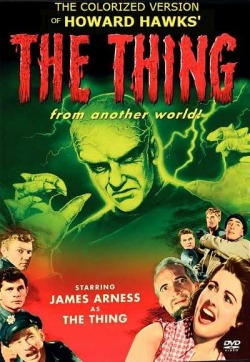
Howard Hawk's 1951 film The Thing From Another World carries with it a theme particular to horror and science fiction films of that era. It appears that following the deployment of the atomic bomb in 1945, America came to villify science and scientists in its cultural output. The postwar period saw the birth of science fiction, and horror moved away from the gothic tales that had defined the genre. Film traded vampires for mad scientists.
But America was still on the upswing following WWII, and the military was commonly favored as the heroic saviors of mankind. The Thing From Another World presents a claustrophobic play between soldiers and aliens, yes, but also a subplot between soldiers and scientists. The scientist insists that The Thing be preserved alive for the sake of science, throwing the rest of the camp into peril. The soldier characters must overcome the meddling scientist and prevent him from abetting their more dangerous adversary.

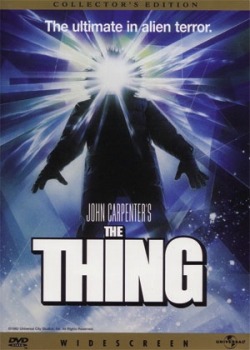
This pro-military, anti-intellectual theme is reversed in John Carpenter's remake from 1982, simply titled The Thing. Concurring with other horror films from the post-Vietnam era (George Romero's Day of the Dead comes to mind), Carpenter portrays the military characters negatively, mired in the chain of command and divorced from the well-being of anyone they outrank. The film portrays scientific knowledge as an exponent of rationalism, which constantly conflicts with the irrationality of the soldier-types.
Curiously, the 1951 feature concludes with victory, while the 1982 remake ends with the almost certain failure of the characters to preserve themselves, or the rest of humanity. This certainly reflects our countries major military conflicts. In 1951, America was unbeaten and invincible, thanks to military bravery. By 1982, Americans had felt defeat in Vietnam, and the country was left feeling defeated and used. Because most conflicts since have played out in largely the same fashion, many horror films since have fallen between two poles of nihilistic resignation to certain doom (sad endings) and reactionary revenge fantasies (happy endings, see last entry).

Also, it is a great honor to have John Kenneth Muir as a "follower" of this blog. Please check out his pages!

Sunday, June 20, 2010

The Last House on the Left + remake


I happened upon the synopsis of Wes Craven's 1972 film The Last House on the Left in John Kenneth Muir's Horror Films of the 1970s, and was intrigued by how such cruelty, which seemed unfilmable as written, could have been filmed. So I found out.

I have a lot of ethical problems with Last House. A little background: Craven made the film under the financing of a drive-in theater owner, to be shown in double features. Craven has admitted that he was on drugs during much of the writing and filming. This doesn't leave a lot of room for artistic integrity. Additionally, this film is a direct copy of Ingmar Bergman's The Virgin Spring, which itself is an adaptation of an old European story of revenge. The best that can be said for Craven's film is that it is a secular reboot of Bergman's film, which concludes with a religious resolution. I ask, is there a point to presenting that which has already been done? I don't think it's necessary to keep repeating an ugly story if the moral is already established.

It should be noted that this film is about rape, murder, and other torturous abuses. At one point in the film where one victim cries as the other consoles her, it's real. The girl did not want to continue shooting. That's kind of sick.

For years I considered Last House to be among the most offensively distasteful films I've seen (coupled with Alexandre Aja's Haute Tension [High Tension]). Then the remake came out in 2009, and warped my whole perspective.

The remake of The Last House on the Left is the same story as told before. But there is one key difference. In the original film, when the parents take their bloody revenge in a bout of passionate rage, they are left feeling empty and sick, shocked at what they have committed. But in the remake, the revenge is portrayed completely as a heroic effort. It's not even done in the heat of the moment. Instead, as two characters make their escape, the father remains behind to perform a torturous execution on the villain, who has been kept as a captive.

So where I cast aspersions on the original for making half-assed and possibly irresponsible moralizations about ethics and guilt, the remake does less than that. This shows that the moral question is essential to the story, and the remake completely disrespects the legacy of its predecessor and cops out to the model of summer movie mindlessness.

PREDICTION: I predicted when this film came out in 2009 that with the incoming Obama administration, the Last House remake would be among the last horror films to center on revenge. I find the total lack of moral questioning in this film and the justification of the most brutal brand of revenge to be complicit with American jingoism and the libertarian bent of mainstream conservative politics. My hope is that with President Obama as the new face of American culture, our cultural output will lose that Toby Keith, boot-in-your-ass, individualistic, revenge-justifying quality that leads to films like this.